KLOW in brief
The name is a sales label, not a chemical name. We found no published source that explains where it came from, so treat it as a brand style name used by many sellers. What matters is what is inside the vial and in what amounts.
KLOW is closely related to GLOW, another blend name. GLOW holds three of the same peptides, and KLOW adds KPV.
Sources: Glow Labs product catalogue, 2026. PubMed searches by Glow Labs, 25 October 2026, titles and abstracts: BPC-157, GHK and KPV (0 records, linked); BPC-157, TB-500 and GHK (6, all reviews); KLOW (32, none on these peptides).
Questions about this guide?
Ask on WhatsAppInside our vial
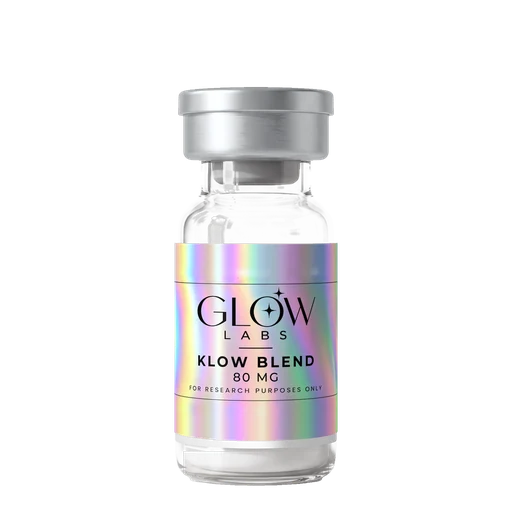
This is the label specification for the Glow Labs KLOW research blend, an 80mg vial. The amounts describe what the vial contains, nothing more.
| Component | Amount in vial | Length | PubChem CID | WADA list |
|---|---|---|---|---|
| GHK-Cu | 50mg | 3 amino acids plus copper | 139035031 | not listed in the pages we read |
| BPC-157 | 10mg | 15 amino acids | 9941957 | S0, banned at all times |
| TB-500 | 10mg | 7 amino acids | 62707662 | S2, banned at all times |
| KPV | 10mg | 3 amino acids | 125672 | not listed in the pages we read |
GHK-Cu makes up well over half of the blend by mass. Other sellers may use different splits under the same KLOW name, so a label from one shop says nothing about another.
Sources: Glow Labs product catalogue, vial label specification: KLOW Blend 80mg (GHK-Cu 50mg, BPC-157 10mg, TB-500 10mg, KPV 10mg); GLOW Blend 70mg (GHK-Cu 50mg, BPC-157 10mg, TB-500 10mg), 2026. PubChem compound record CID 139035031 (copper tripeptide, GHK-Cu), US National Library of Medicine. PubChem compound record CID 9941957 (BPC-157), US National Library of Medicine. PubChem compound record CID 62707662 (TB-500), US National Library of Medicine. PubChem compound record CID 125672 (Lys-Pro-Val, MSH 11 to 13), US National Library of Medicine. Sport Integrity Australia, BPC-157 substance education page. Sport Integrity Australia, Thymosin beta-4 substance information.
The four parts
GHK-Cu
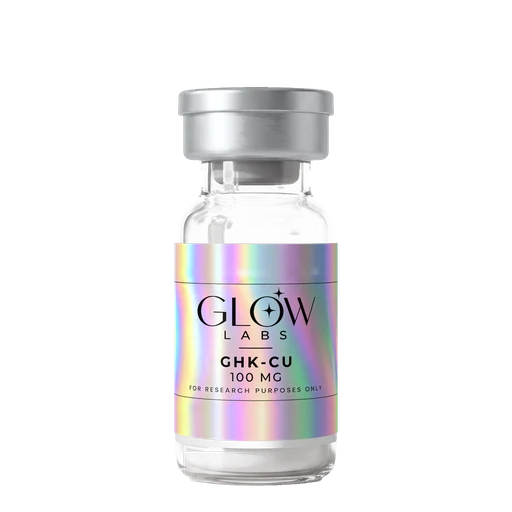
A copper carrying tripeptide of glycine, histidine and lysine, first reported in human plasma. Its research centres on skin cells, collagen and gene expression in the lab. Our GHK-Cu guide has the detail, and single vials are on the GHK-Cu page.
BPC-157
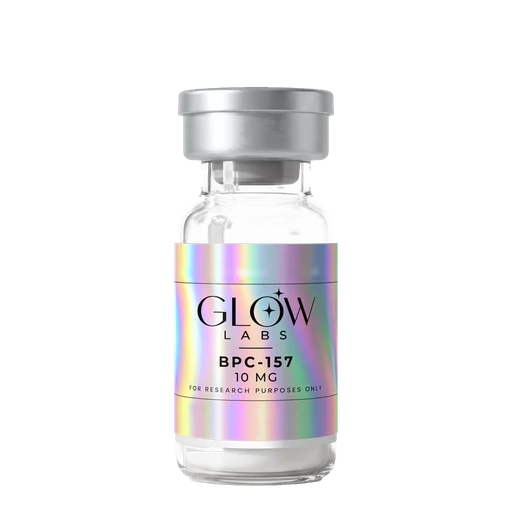
A 15 unit chain modelled on a stomach protein, studied mainly in rat tissue models since the 1990s. The review we cite notes a lack of full clinical studies in people. Read what BPC-157 is or see the BPC-157 page.
TB-500
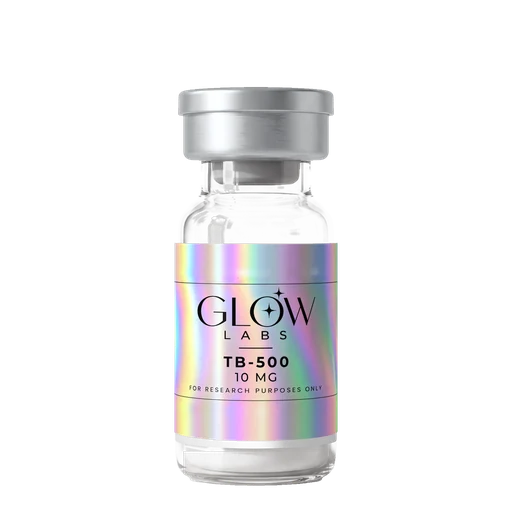
A seven unit fragment of thymosin beta-4, the actin binding protein. It is better known to doping labs than to clinical researchers. Single vials are on the TB-500 page.
KPV
This tripeptide matches the final stretch of alpha-MSH, a hormone the body makes. Its three units are lysine, proline and valine. A 2008 study found that cells take KPV in through a transporter called PepT1. The same study measured lower NF-kB activity when KPV was added to gut cells, and tested it in two mouse colitis models. Our guide on what KPV is covers it, and the KPV page lists single vials.
Sources: PubChem compound record CID 9941957 (BPC-157), US National Library of Medicine. PubChem compound record CID 62707662 (TB-500), US National Library of Medicine. PubChem compound record CID 125672 (Lys-Pro-Val, MSH 11 to 13), US National Library of Medicine. Pickart L et al, GHK Peptide as a Natural Modulator of Multiple Cellular Pathways in Skin Regeneration, Biomed Res Int, 2015. Józwiak M et al, Pharmaceuticals (Basel), 2025. Esposito S et al, Drug Test Anal, 2012. Dalmasso G et al, PepT1-mediated tripeptide KPV uptake reduces intestinal inflammation, Gastroenterology, 2008.
Has it been studied?
No, not as a blend. On 25 October 2026 we searched PubMed titles and abstracts for papers naming BPC-157, GHK and KPV together and found none. A wider search for BPC-157, TB-500 and GHK found six papers, and all six are reviews or overview articles that discuss each peptide on its own. Searching "KLOW" returned 32 records about unrelated topics.
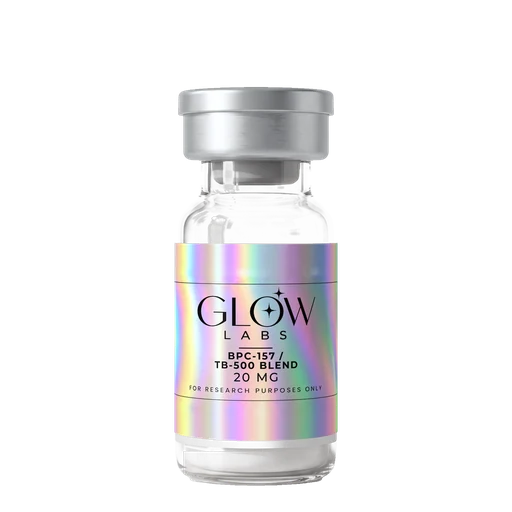
So any claim about what the four do together is not based on published research. Each part has to be judged on its own studies. Labs that only want the BPC-157 and TB-500 pair can use the two peptide blend.
Reading a blend COA
A certificate of analysis for a single peptide reports one identity and one purity figure. A four part blend is harder. A useful blend certificate should show:
- a separate peak or identity check for each of the four peptides
- the measured amount of each one, compared with the label
- the total purity, and how it was worked out
- a batch number that matches the vial
A single purity number for the whole vial does not tell you whether each part is present in the right amount. Our peptide purity guide explains HPLC and mass spec in plain terms. Glow Labs certificates are available on request.
KLOW vs GLOW
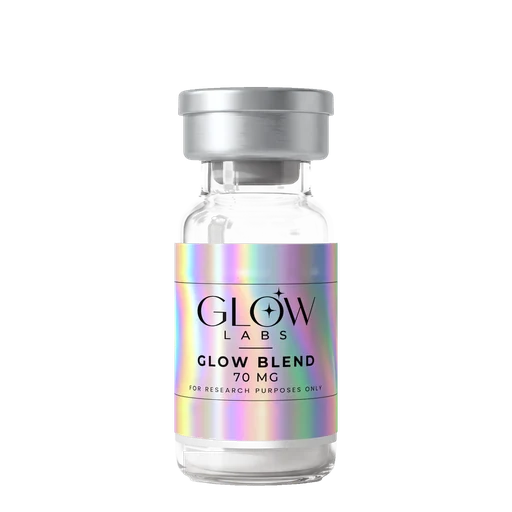
GLOW is the closest relative of KLOW, and the gap between them is a single peptide. Set the two catalogue labels next to each other and three lines are identical. KLOW simply carries KPV as its fourth part.
| In the vial | GLOW blend, 70mg | KLOW blend, 80mg |
|---|---|---|
| GHK-Cu | 50mg | 50mg |
| BPC-157 | 10mg | 10mg |
| TB-500 | 10mg | 10mg |
| KPV | not included | 10mg |
That extra KPV accounts for the 10mg difference in total vial size. Neither blend has been tested as a mix, so the comparison is about contents, not effects. GLOW is also a market name used by many sellers.
Sources: Glow Labs product catalogue, 2026. PubMed searches by Glow Labs, 25 October 2026, titles and abstracts: BPC-157, GHK and KPV (0 records, linked); BPC-157, TB-500 and GHK (6, all reviews); KLOW (32, none on these peptides).
Status in Australia
The TGA's 2026 safety advisory names GHK-Cu, BPC-157 and TB-500 among unapproved peptide products. KPV did not come up on the regulator pages we checked, and that silence does not make it permitted. The regulator has also said that RUO wording on a label is not a legal shield by itself.
BPC-157 and TB-500 are both named in Schedule 4 of the October 2026 Poisons Standard, and again in its Appendix D, clause 5.
Sport Integrity Australia lists BPC-157 under S0 and thymosin beta-4, which includes TB-500, under S2 of the WADA Prohibited List.
Glow Labs sends vials anywhere in Australia with fast delivery and tracking, 2-3 days.
Sources: Therapeutic Goods Administration, Understanding your responsibilities when importing, compounding and supplying unapproved peptide products, Safety advisory, 13 April 2026. Sport Integrity Australia, BPC-157 substance education page. Sport Integrity Australia, Thymosin beta-4 substance information. Therapeutic Goods (Poisons Standard, October 2026) Instrument 2026 (F2026L01327): Schedule 4 and Appendix D, clause 5 entries for BPC-157 and TB-500, Federal Register of Legislation, Australian Government.
Research use only
KLOW is sold as lyophilised powder for laboratory research. It is not a medicine or a cosmetic, and it is not for people or animals.
FAQ
Is KLOW one peptide?
No. It is four peptides in one vial: GHK-Cu, BPC-157, TB-500 and KPV.
Has the KLOW blend been studied?
Not that we could find. Our dated PubMed search found no paper testing these four together, only reviews that cover each peptide separately.
What is the difference between KLOW and GLOW?
GLOW has three peptides, GHK-Cu, BPC-157 and TB-500. KLOW adds KPV as a fourth.
Why do different shops list different amounts?
KLOW is a market name with no fixed recipe. Each supplier sets its own split, so compare labels and certificates rather than names.
Sources: Glow Labs product catalogue, 2026. PubMed searches by Glow Labs, 25 October 2026, titles and abstracts: BPC-157, GHK and KPV (0 records, linked); BPC-157, TB-500 and GHK (6, all reviews); KLOW (32, none on these peptides).
Sources
- Glow Labs product catalogue, vial label specification: KLOW Blend 80mg (GHK-Cu 50mg, BPC-157 10mg, TB-500 10mg, KPV 10mg); GLOW Blend 70mg (GHK-Cu 50mg, BPC-157 10mg, TB-500 10mg), 2026.
- PubChem compound record CID 139035031 (copper tripeptide, GHK-Cu), US National Library of Medicine.
- PubChem compound record CID 9941957 (BPC-157), US National Library of Medicine.
- PubChem compound record CID 62707662 (TB-500), US National Library of Medicine.
- PubChem compound record CID 125672 (Lys-Pro-Val, MSH 11 to 13), US National Library of Medicine.
- Pickart L et al, GHK Peptide as a Natural Modulator of Multiple Cellular Pathways in Skin Regeneration, Biomed Res Int, 2015.
- Józwiak M et al, Pharmaceuticals (Basel), 2025.
- Esposito S et al, Drug Test Anal, 2012.
- Dalmasso G et al, PepT1-mediated tripeptide KPV uptake reduces intestinal inflammation, Gastroenterology, 2008.
- PubMed searches by Glow Labs, 25 October 2026, titles and abstracts: BPC-157, GHK and KPV (0 records, linked); BPC-157, TB-500 and GHK (6, all reviews); KLOW (32, none on these peptides).
- Therapeutic Goods Administration, Understanding your responsibilities when importing, compounding and supplying unapproved peptide products, Safety advisory, 13 April 2026.
- Sport Integrity Australia, BPC-157 substance education page.
- Sport Integrity Australia, Thymosin beta-4 substance information.
- Therapeutic Goods (Poisons Standard, October 2026) Instrument 2026 (F2026L01327): Schedule 4 and Appendix D, clause 5 entries for BPC-157 and TB-500, Federal Register of Legislation, Australian Government.
- Glow Labs product catalogue, 2026.