GHK-Cu in brief
The letters GHK are the one letter codes for its three amino acids: G for glycine, H for histidine and K for lysine. "Cu" is the chemical symbol for copper. On skincare labels the copper complex is usually called copper tripeptide-1.
GHK grabs copper very tightly. Much of the research interest comes from that link, because copper is needed by many enzymes in the body.
Sources: PubChem compound record CID 73587 (glycyl-L-histidyl-L-lysine), US National Library of Medicine. PubChem compound record CID 139035031 (copper tripeptide, GHK-Cu), US National Library of Medicine. Mateescu DM et al, Pharmaceutics, 2026.
Questions about this guide?
Ask on WhatsAppWhere it was found
Loren Pickart and Martin Thaler reported a growth-modulating tripeptide in human serum in 1973, and a 1977 paper by Pickart and colleagues identified it as glycyl-histidyl-lysine. In 1980 Pickart and Thaler reported that it travels with copper and iron in plasma. Pickart's later reviews state that GHK is present in plasma, saliva and urine, and that the amount in plasma drops as people get older.
Much of the early GHK literature comes from Pickart and co-workers, which is worth keeping in mind when reading the reviews.
Sources: Pickart L, Thaler MM, Tripeptide in human serum which prolongs survival of normal liver cells and stimulates growth in neoplastic liver, Nat New Biol, 1973. Schlesinger DH, Pickart L, Thaler MM, Growth-modulating serum tripeptide is glycyl-histidyl-lysine, Experientia, 1977. Pickart L, Thaler MM, J Cell Physiol, 1980. Pickart L, The human tri-peptide GHK and tissue remodeling, J Biomater Sci Polym Ed, 2008. Pickart L et al, GHK Peptide as a Natural Modulator of Multiple Cellular Pathways in Skin Regeneration, Biomed Res Int, 2015.
Structure and copper
| Property | GHK peptide | GHK-Cu complex |
|---|---|---|
| Amino acids | Gly-His-Lys | Gly-His-Lys plus copper(II) |
| Formula | C14H24N6O4 | C14H21CuN6O4 |
| Molecular weight | 340.38 g/mol | 400.90 g/mol |
| PubChem CID | 73587 | 139035031 |
A 2020 computer modelling study looked at exactly how copper sits in the peptide. It found four stable bonds holding the copper in a flat ring, three from nitrogen atoms and one from oxygen, with a looser fifth bond above.
Sources: PubChem compound record CID 73587 (glycyl-L-histidyl-L-lysine), US National Library of Medicine. PubChem compound record CID 139035031 (copper tripeptide, GHK-Cu), US National Library of Medicine. Alshammari N, Platts JA, Theoretical study of copper binding to GHK peptide, Comput Biol Chem, 2020.
What was studied
Cell and gene work
Lab studies show GHK-Cu can change how some skin cells make collagen and related molecules. These cells are called fibroblasts. A 2015 review also points to gene data from human cell lines. In those tests, GHK shifted the activity of thousands of genes. These are lab signals in dishes, not proof of any effect in a person.
Animal wound models
Reviews describe wound studies in rats, mice, pigs and dogs. In these, GHK-Cu was put on injured tissue.
Cosmetic studies and the skin barrier
Cosmetic studies in people have been small. A 2026 review that graded the evidence called the clinical record sparse. One 13 person study after laser skin treatment found no change on objective measures. A separate problem is getting the molecule into skin at all. A 2025 review notes that GHK-Cu dissolves well in water. But it passes poorly through the oily outer layer of skin.
Sources: Pickart L, The human tri-peptide GHK and tissue remodeling, J Biomater Sci Polym Ed, 2008. Pickart L et al, GHK Peptide as a Natural Modulator of Multiple Cellular Pathways in Skin Regeneration, Biomed Res Int, 2015. Ogórek K et al, Molecules, 2025. Mateescu DM et al, Pharmaceutics, 2026.
Vial vs serum
Searches for "copper peptides" mix up very different things. This table separates them.
| Product | What it is | Form | Rules that apply |
|---|---|---|---|
| Research vial | GHK-Cu powder; certificates of analysis available on request | lyophilised powder | sold for lab research only; listed by the TGA as an unapproved peptide |
| Skincare serum | copper tripeptide-1 in a cream or liquid base | ready mixed | sold as a cosmetic; some "copper" serums use copper ingredients that are not GHK |
A research vial is not a skincare product, and a serum label is not a purity test. The ingredient name on the box is the only way to tell which copper ingredient you are looking at.
Sources: PubChem compound record CID 139035031 (copper tripeptide, GHK-Cu), US National Library of Medicine. Ogórek K et al, Molecules, 2025. Mateescu DM et al, Pharmaceutics, 2026. Therapeutic Goods Administration, Understanding your responsibilities when importing, compounding and supplying unapproved peptide products, Safety advisory, 13 April 2026.
What is not known
A 2026 review sums up the gap well. Animal and cell data are fairly consistent, but human evidence is thin and often does not say exactly which copper form was used. A phase 2 trial in acute wounds was still recruiting when that review was written, with nothing reported.
A separate 2026 review notes that these unapproved peptides are sold largely outside regulatory oversight and that human safety data are scarce.
Sources: Mateescu DM et al, Pharmaceutics, 2026. Mendias CL, Awan TM, Sports Med, 2026.
GHK-Cu and AHK-Cu
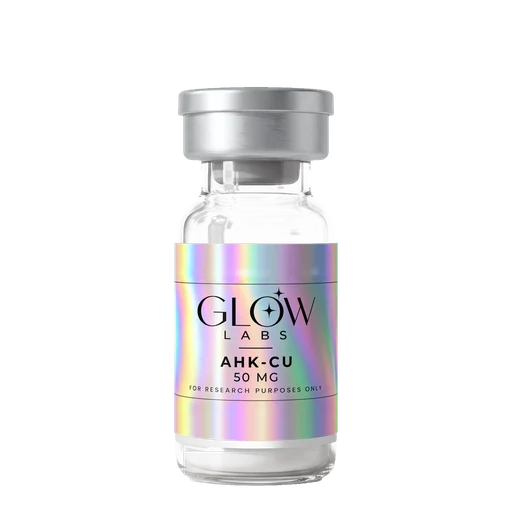
AHK-Cu swaps the first amino acid, glycine, for alanine. That one change gives a different molecule with a far smaller research record. See how AHK-Cu differs, or the AHK-Cu research page.
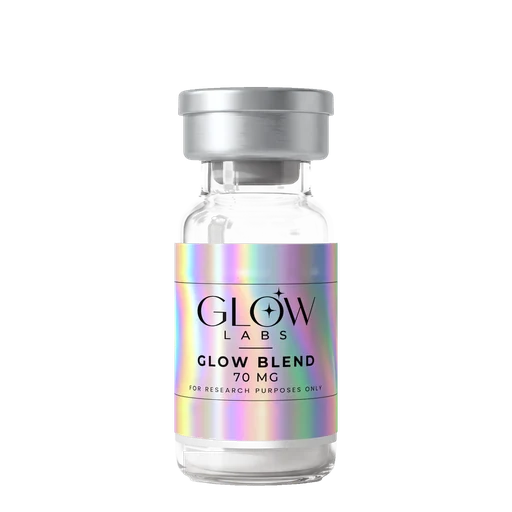
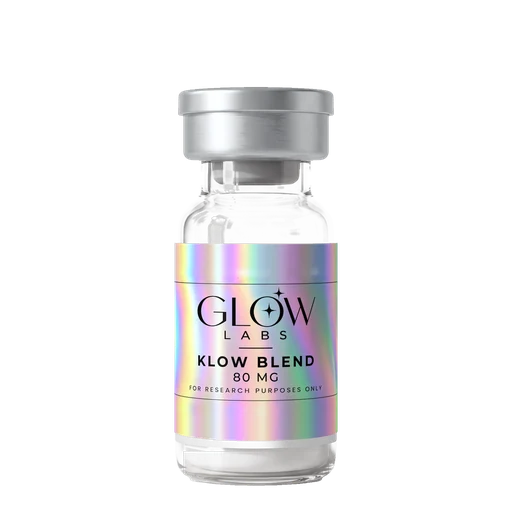
GHK-Cu is also one of the three parts of the GLOW blend and one of four in the KLOW blend, explained in our KLOW guide.
Status in Australia
GHK-Cu is not an approved medicine in Australia. The TGA's 2026 safety alert names GHK-Cu as an example of an unapproved peptide product. That alert also warns sellers that a research only tag gives no legal cover on its own.
Glow Labs ships vials Australia wide, with tracked delivery in 2-3 days.
Research use only
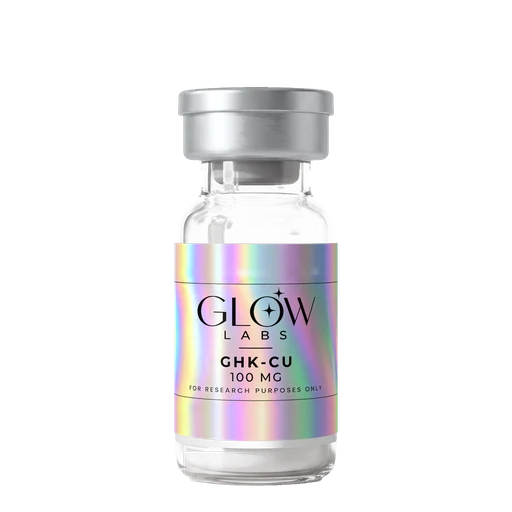
Our GHK-Cu research vials are lyophilised powder sold for laboratory research. They are not cosmetics and are not for people or animals.
FAQ
Is GHK-Cu the same as the copper peptides in serums?
Sometimes. Serums labelled copper tripeptide-1 contain the GHK-Cu complex in a cream or liquid base. Other "copper" serums use different copper ingredients that are not GHK.
What is the difference from AHK-Cu?
One amino acid. GHK starts with glycine and AHK starts with alanine. GHK-Cu has decades of studies, while AHK-Cu has very few.
Is GHK-Cu approved in Australia?
No. It appears on the TGA's 2026 list of unapproved peptide examples.
Has GHK-Cu been tested in clinical trials?
Only in small numbers. A 2026 review found the clinical record sparse, and a phase 2 wound trial had not reported anything when that review was written.
Sources: PubChem compound record CID 139035031 (copper tripeptide, GHK-Cu), US National Library of Medicine. Alshammari N, Platts JA, Theoretical study of copper binding to GHK peptide, Comput Biol Chem, 2020. Mateescu DM et al, Pharmaceutics, 2026. Therapeutic Goods Administration, Understanding your responsibilities when importing, compounding and supplying unapproved peptide products, Safety advisory, 13 April 2026.
Sources
- PubChem compound record CID 73587 (glycyl-L-histidyl-L-lysine), US National Library of Medicine.
- PubChem compound record CID 139035031 (copper tripeptide, GHK-Cu), US National Library of Medicine.
- Pickart L, Thaler MM, Growth-modulating tripeptide (glycylhistidyllysine): association with copper and iron in plasma, and stimulation of adhesiveness and growth of hepatoma cells in culture by tripeptide-metal ion complexes, J Cell Physiol, 1980.
- Pickart L, The human tri-peptide GHK and tissue remodeling, J Biomater Sci Polym Ed, 2008.
- Pickart L et al, GHK Peptide as a Natural Modulator of Multiple Cellular Pathways in Skin Regeneration, Biomed Res Int, 2015.
- Alshammari N, Platts JA, Theoretical study of copper binding to GHK peptide, Comput Biol Chem, 2020.
- Ogórek K et al, Molecules, 2025.
- Mateescu DM et al, Pharmaceutics, 2026.
- Mendias CL, Awan TM, Sports Med, 2026.
- Therapeutic Goods Administration, Understanding your responsibilities when importing, compounding and supplying unapproved peptide products, Safety advisory, 13 April 2026.
- Pickart L, Thaler MM, Tripeptide in human serum which prolongs survival of normal liver cells and stimulates growth in neoplastic liver, Nat New Biol, 1973.
- Schlesinger DH, Pickart L, Thaler MM, Growth-modulating serum tripeptide is glycyl-histidyl-lysine, Experientia, 1977.