Discreet packaging
Plain outer packaging on every order.

 Sold out, pre-orderResearch use only
Beauty research
GLOW peptide Australia: the Glow Labs GLOW Blend is a 70mg freeze-dried vial that, per the vial label, combines three peptides: GHK-Cu, BPC-157 and TB-500. It belongs to our beauty research range and is meant for bench study alone. It is sold out right now, so pre-order on WhatsApp. When it is back in stock, it goes out tracked from Gippsland, Victoria, and arrives anywhere in the country in 2-3 days.
Size
Price confirmed on WhatsApp before you pay
Sold out Stocking soon. Message us to pre-order.
Research use only. Not for human consumption.
Plain outer packaging on every order.
Orders leave Traralgon in the afternoon during business hours, then travel tracked to your door.
Certificates of analysis available on request.
If a vial arrives damaged, broken or not what you ordered, message us within 7 days with a photo and we'll replace it free.
What it is
The supplier label lists 70mg in total, split like this:
GLOW and KLOW share these three peptides, and KLOW adds a fourth, KPV.
Certificates of analysis are available on request.
Questions about GLOW Blend?
Ask on WhatsAppThe notes below describe each compound from its own research, never the mixture.
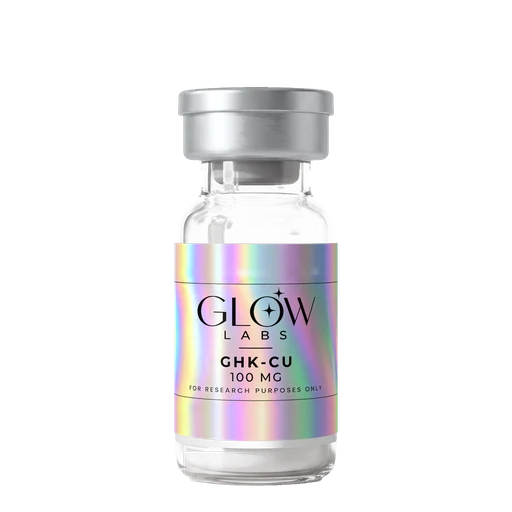
GHK-Cu: a copper complex of the tripeptide Gly-His-Lys, which occurs in human plasma. Its literature is mainly cell and gene expression work reviewed by Pickart's group.
BPC-157: a pentadecapeptide, GEPPPGKPADDAGLV, whose research base is largely rodent soft tissue injury models, according to a 2019 review.
TB-500: seven residues copied from positions 17 to 23 of thymosin beta-4, capped with an acetyl group, as a 2012 equine doping control paper describes.
Sources: PubChem compound record: Prezatide copper (copper tripeptide-1, GHK-Cu) (CID 71587328), US National Library of Medicine. Pickart L et al, GHK peptide as a natural modulator of multiple cellular pathways in skin regeneration, Biomed Res Int, 2015. PubChem compound record: BPC-157 (CID 9941957), US National Library of Medicine. Gwyer D, Wragg NM, Wilson SL, Cell Tissue Res, 2019. Ho EN et al, J Chromatogr A, 2012. PubChem compound record: TB-500 (CID 62707662), US National Library of Medicine.
No peer reviewed paper we could find has tested GHK-Cu, BPC-157 and TB-500 together. This page makes no claim about what the blend might do.
Copper peptide makes up five sevenths of the powder by weight, so the other two parts are minor by mass.
Each peptide has its own mass in PubChem: GHK-Cu about 403 g/mol, BPC-157 about 1419 and TB-500 about 889, so a blend certificate can check each one.
A single purity figure for the whole vial cannot show that all three are present.
Sources: PubChem compound record: Prezatide copper (copper tripeptide-1, GHK-Cu) (CID 71587328), US National Library of Medicine. PubChem compound record: BPC-157 (CID 9941957), US National Library of Medicine. PubChem compound record: TB-500 (CID 62707662), US National Library of Medicine.
Peptide suppliers advise keeping any freeze-dried peptide below -15 °C in a tightly closed vial. The cold, dry and dark rules apply to all of the powder in the vial.
Peptide powder tends to absorb moisture from the air. Let the vial warm up before opening, close it promptly, and avoid keeping it in solution.
Sources: Bachem, Handling and storage guidelines for peptides, Knowledge Center. JPT Peptide Technologies, How to store peptides: best practices for researchers.
Specification
| Name | GLOW Blend |
|---|---|
| Sizes | 70mg |
| Form | Lyophilised powder (three-peptide blend) |
| Vial | 3 ml glass vial |
| Cap | Brushed silver-grey |
| Sequence | Label: 50mg GHK-Cu + 10mg BPC-157 + 10mg TB-500 |
| Structure | Three peptides freeze-dried as one powder. Amounts are from the supplier label. |
| Storage | Treat it like its most delicate component: sealed, frozen, dry and dark. |
| Certificate | On request, how to ask |
| Status | Sold out, stocking soon |
| Use | Laboratory research only |
Sources: Bachem, Handling and storage guidelines for peptides, Knowledge Center. JPT Peptide Technologies, How to store peptides: best practices for researchers.
Regulatory status
The TGA lists all three GLOW components among unapproved peptides. The blend is a lab material, and Glow Labs supplies it only for research settings.
Two of those three, BPC-157 and TB-500, are also Schedule 4 poisons in the October 2026 Poisons Standard. Appendix D, clause 5 names both, so a person needs authority under local state or territory law to possess them.
Sources: Therapeutic Goods Administration, Peptide products (topic page). Therapeutic Goods Administration, Understanding your responsibilities when importing, compounding and supplying unapproved peptide products, Safety advisory, 13 April 2026. Therapeutic Goods (Poisons Standard, October 2026) Instrument 2026 (F2026L01327): Schedule 4 and Appendix D, clause 5 entries for BPC-157 and TB-500, Federal Register of Legislation, Australian Government.
Testing
Certificates of analysis are available on request. Ask us on WhatsApp before or after you order.
How ordering works
Add compounds and quantities. No account needed.
One tap writes your whole order into a WhatsApp message.
We confirm stock and your total, share payment details, then ship tracked.
FAQ
Per the vial label: 50mg GHK-Cu, 10mg BPC-157 and 10mg TB-500, for 70mg in all.
KLOW contains the same three peptides as GLOW plus KPV.
No published study we could find tests these three together. Each peptide has been studied on its own.
Frozen, sealed, dry and dark. A blend is only as stable as its most delicate component, so open it as rarely as possible and let it warm first.
Sources: PubChem compound record: Prezatide copper (copper tripeptide-1, GHK-Cu) (CID 71587328), US National Library of Medicine. PubChem compound record: BPC-157 (CID 9941957), US National Library of Medicine. PubChem compound record: TB-500 (CID 62707662), US National Library of Medicine.
Questions before you order?
Ask on WhatsApp