KPV in brief
KPV is one of the smallest peptides you will see in a research catalogue. A peptide is a short chain of amino acids. Proteins are built from those same units, only in much longer chains. KPV is a chain of just three.
Those three links are the last three of alpha-MSH, which is 13 amino acids long. Researchers wanted to know if this tiny tail could still do some of what the whole hormone does. That question has driven more than forty years of lab work.
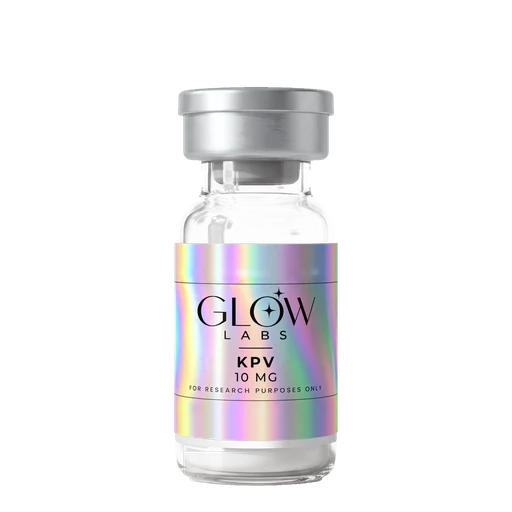
Glow Labs supplies KPV research vials as freeze-dried powder for laboratory study only.
Sources: PubChem, Msh (11-13), Lys-Pro-Val, CID 125672, National Library of Medicine. Hiltz ME, Lipton JM, Antiinflammatory activity of a COOH-terminal fragment of the neuropeptide alpha-MSH, FASEB J, 1989.
Questions about this guide?
Ask on WhatsAppWhat K, P and V mean
Chemists give each amino acid a one-letter code. K stands for lysine, P for proline and V for valine. So the name KPV is simply the sequence written in code, read from left to right. You may also see it written as Lys-Pro-Val, or as alpha-MSH 11-13, which means positions 11 to 13 of the parent hormone.
| Property | Value |
|---|---|
| Sequence | Lys-Pro-Val (K-P-V) |
| Other name | alpha-MSH (11-13) |
| Length | 3 amino acids |
| Formula | C16H30N4O4 |
| Molecular weight | 342.43 g/mol |
| PubChem record | CID 125672 |
| Supplied as | lyophilised powder |
Sources: PubChem, Msh (11-13), Lys-Pro-Val, CID 125672, National Library of Medicine.
Where KPV comes from
Alpha-MSH is a melanocortin. That is a family of hormones the body makes from one larger parent protein. Alpha-MSH is best known for its link to skin colour, but scientists also found it reduces certain immune signals in lab tests.
In 1984, a team gave the three-amino-acid tail to rabbits with a fever and measured body temperature. They found the short piece had some activity, though it was less potent than the full hormone. In 1989 the same group tested it on ear swelling in mice. These two papers are why KPV became a research topic at all. A 2010 review sums up how the wider melanocortin family is studied in inflammation research.
Sources: Richards DB, Lipton JM, Effect of alpha-MSH 11-13 (lysine-proline-valine) on fever in the rabbit, Peptides, 1984. Hiltz ME, Lipton JM, Antiinflammatory activity of a COOH-terminal fragment of the neuropeptide alpha-MSH, FASEB J, 1989. Catania A et al, The melanocortin system in control of inflammation, ScientificWorldJournal, 2010.
Research timeline
Here is the research record laid out by year. Every row is a published study, and the second column shows what kind of model was used. Read down the column and you will see the pattern: cells, rabbits and mice, with no human trial yet.
| Year | Model | What the team looked at |
|---|---|---|
| 1984 | Rabbits | Body temperature after a fever was triggered |
| 1989 | Mice | Ear swelling caused by a skin irritant |
| 2004 | Human skin cells in a dish | Calcium and cyclic AMP signals inside keratinocytes |
| 2006 | Rabbits | Healing of a scraped cornea, and the role of nitric oxide |
| 2008 | Human gut and immune cells, then mice | Uptake through the PepT1 transporter and two colitis models |
| 2008 | Mice | Two more bowel inflammation models, including mice lacking a working MC1 receptor |
| 2017 | Mice | KPV packed into nanoparticles and given by mouth in a colitis model |
The 2004 study used human cells grown in a lab, not people. That difference matters. A finding in a dish tells researchers where to look next. It does not show what would happen in a living person.
Sources: Richards DB, Lipton JM, Effect of alpha-MSH 11-13 (lysine-proline-valine) on fever in the rabbit, Peptides, 1984. Hiltz ME, Lipton JM, Antiinflammatory activity of a COOH-terminal fragment of the neuropeptide alpha-MSH, FASEB J, 1989. Elliott RJ et al, alpha-Melanocyte-stimulating hormone, MSH 11-13 KPV and adrenocorticotropic hormone signalling in human keratinocyte cells, J Invest Dermatol, 2004. Bonfiglio V et al, Exp Eye Res, 2006. Dalmasso G et al, PepT1-mediated tripeptide KPV uptake reduces intestinal inflammation, Gastroenterology, 2008. Kannengiesser K et al, Melanocortin-derived tripeptide KPV has anti-inflammatory potential in murine models of inflammatory bowel disease, Inflamm Bowel Dis, 2008. Xiao B et al, Mol Ther, 2017.
How it may act
Researchers have put forward a few ideas, all from cell and animal work.
- PepT1 uptake. PepT1 is a transporter in gut cells that carries small peptides inside. The 2008 Gastroenterology paper reported that KPV enters cells this way.
- NF-kB signalling. NF-kB is a switch inside cells that turns on inflammatory genes. The same team measured lower NF-kB activity when KPV was present.
- Receptor questions. Alpha-MSH acts on the MC1 receptor. A second 2008 team tested KPV in mice without a working MC1 receptor and still saw activity, which suggests KPV works at least partly without that receptor.
Each of these is a working idea, not a settled fact.
Sources: Elliott RJ et al, alpha-Melanocyte-stimulating hormone, MSH 11-13 KPV and adrenocorticotropic hormone signalling in human keratinocyte cells, J Invest Dermatol, 2004. Dalmasso G et al, PepT1-mediated tripeptide KPV uptake reduces intestinal inflammation, Gastroenterology, 2008. Kannengiesser K et al, Melanocortin-derived tripeptide KPV has anti-inflammatory potential in murine models of inflammatory bowel disease, Inflamm Bowel Dis, 2008.
What is unknown
The biggest gap is simple. A ClinicalTrials.gov check on 25 October 2026 for studies using KPV found none. A PubMed search for clinical trial records about KPV also returned zero. So there is no controlled human data to report.
Other open questions include how long the peptide lasts in the body, how stable it is outside the gut, and whether the mouse models match any human disease closely. Until those are studied, any claim that KPV helps people goes beyond the evidence.
Sources: ClinicalTrials.gov search for KPV as an intervention, run 25 October 2026 (0 studies). PubMed search "KPV[tiab] AND clinical trial[pt]", run 25 October 2026 (0 records).
KPV in KLOW
KPV is one of four peptides in the KLOW blend. Our guide to the four-peptide KLOW blend explains what else is in the vial and why sellers group them. If your research needs KPV on its own, the single vial is the cleaner choice because nothing else is mixed in.
Status in Australia
KPV is not named in the TGA or Sport Integrity Australia pages we read for this guide. That silence is not permission. In its April 2026 alert, the TGA said unapproved peptide products have not been assessed for safety, quality or effectiveness. The same alert says a research use only label does not by itself make supply lawful.
Glow Labs sells KPV for laboratory research only, not for people or animals. We post orders from Traralgon in Gippsland, VIC, during afternoon business hours. Fast delivery and tracking, 2-3 days. For handling, see our guide on how to store peptides.
FAQ
What does KPV stand for?
KPV is the one-letter code for its three amino acids: K for lysine, P for proline and V for valine. It is not an acronym for anything else.
Where does KPV come from?
It comes from the end of alpha-MSH, a 13 amino acid hormone in the melanocortin family. KPV matches positions 11 to 13. Lab versions are made by chemical synthesis.
Has KPV been studied in people?
Not in a completed controlled trial. Searches of ClinicalTrials.gov and PubMed in October 2026 found no human trials. The published work uses cells, rabbits and mice.
Is KPV the same as alpha-MSH?
No. KPV is only the tail end of alpha-MSH, 3 amino acids out of 13. A 1984 study found it less potent than the full hormone.
Is KPV approved as a medicine anywhere?
We found no approval in the sources we checked. Our ClinicalTrials.gov and PubMed searches found no completed human trial, and the TGA and Sport Integrity Australia pages we read do not name it.
Sources
- PubChem, Msh (11-13), Lys-Pro-Val, CID 125672, National Library of Medicine.
- Richards DB, Lipton JM, Effect of alpha-MSH 11-13 (lysine-proline-valine) on fever in the rabbit, Peptides, 1984.
- Hiltz ME, Lipton JM, Antiinflammatory activity of a COOH-terminal fragment of the neuropeptide alpha-MSH, FASEB J, 1989.
- Catania A et al, The melanocortin system in control of inflammation, ScientificWorldJournal, 2010.
- Elliott RJ et al, alpha-Melanocyte-stimulating hormone, MSH 11-13 KPV and adrenocorticotropic hormone signalling in human keratinocyte cells, J Invest Dermatol, 2004.
- Bonfiglio V et al, Effects of the COOH-terminal tripeptide alpha-MSH(11-13) on corneal epithelial wound healing: role of nitric oxide, Exp Eye Res, 2006.
- Dalmasso G et al, PepT1-mediated tripeptide KPV uptake reduces intestinal inflammation, Gastroenterology, 2008.
- Kannengiesser K et al, Melanocortin-derived tripeptide KPV has anti-inflammatory potential in murine models of inflammatory bowel disease, Inflamm Bowel Dis, 2008.
- Xiao B et al, Mol Ther, 2017.
- ClinicalTrials.gov search for KPV as an intervention, run 25 October 2026 (0 studies).
- PubMed search "KPV[tiab] AND clinical trial[pt]", run 25 October 2026 (0 records).
- Therapeutic Goods Administration, Understanding your responsibilities when importing, compounding and supplying unapproved peptide products, Safety advisory, 13 April 2026.