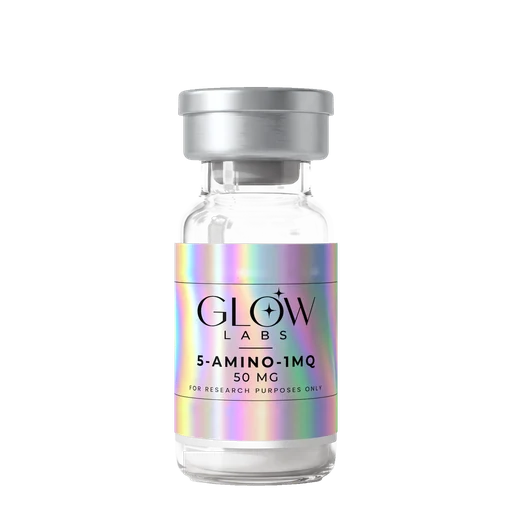
What is 5-amino-1MQ?
| Fact | Detail |
|---|---|
| What it is | Lab-made quinolinium compound, not a peptide |
| Full name | 5-amino-1-methylquinolinium |
| Formula | C10H11N2+ |
| Molecular weight | 159.21 g/mol |
| Enzyme it blocks | NNMT (nicotinamide N-methyltransferase) |
| Strongest evidence so far | Mouse studies, after enzyme and cell tests |
| Registered human studies | 0 on ClinicalTrials.gov, 26 October 2026 |
The plus sign in the formula is not a typo. The nitrogen in its ring carries a fixed positive charge, which is why chemists call it a quinolinium.
Sources: PubChem, 5-Amino-1-methylquinolinium, CID 950107, National Library of Medicine. Neelakantan H et al, Biochem Pharmacol, 2018. ClinicalTrials.gov searches for 5-amino-1MQ and 5-amino-1-methylquinolinium, run 26 October 2026 (0 studies).
Questions about this guide?
Ask on WhatsAppNot a peptide
A peptide is a chain of amino acids joined by peptide bonds. 5-amino-1MQ has none of either. It is two fused carbon rings with one nitrogen, an amino group and a methyl group.
Shops often list it beside peptides, and that habit has spread into search, where "5 amino 1mq peptide" is a common phrase.
| 5-amino-1MQ | Glutathione | BPC-157 | |
|---|---|---|---|
| Type | Small molecule | Peptide | Peptide |
| Amino acids | 0 | 3 | 15 |
| Links between amino acids | 0 | 2 | 14 |
| Formula | C10H11N2+ | C10H17N3O6S | C62H98N16O22 |
| Molecular weight | 159.21 g/mol | 307.33 g/mol | 1419.5 g/mol |
Glutathione is one of the smallest peptides there is, and it is still almost twice as heavy. BPC-157 is about nine times heavier. SLU-PP-332 is the other non-peptide in our catalogue, and our SLU-PP-332 guide explains it.
Sources: PubChem, 5-Amino-1-methylquinolinium, CID 950107, National Library of Medicine. PubChem, Glutathione, CID 124886, National Library of Medicine. PubChem, Bpc-157, CID 9941957, National Library of Medicine.
What NNMT does
NNMT is an enzyme inside cells. Its job is to move a small chemical tag, a methyl group, onto nicotinamide. Nicotinamide is a form of vitamin B3.
The pathway in three steps:
- A donor molecule called SAM hands over a methyl group.
- NNMT places it on nicotinamide, making 1-methylnicotinamide.
- That tagged nicotinamide can no longer be recycled into NAD+.
NAD+ is a coenzyme that cells use in energy chemistry, and our guide on what NAD is covers it. Because nicotinamide can go either way, scientists study whether blocking NNMT changes the balance. A 2014 Nature paper switched the NNMT gene down in mice to test this idea. That study used gene tools, not 5-amino-1MQ.
Sources: Neelakantan H et al, Biochem Pharmacol, 2018. Kraus D et al, Nature, 2014.
How it was found
In 2017 a US team led by Harshini Neelakantan and Stanley Watowich screened groups of small ring-shaped compounds for NNMT blocking. They compared quinoliniums, isoquinoliniums and several others. Activity across the set varied more than a thousand-fold. Quinoliniums stood out as the most promising family, and 5-amino-1MQ is one of them.
What was measured
Enzyme and cell work
A 2018 paper by the same group tested how well these quinolinium compounds cross cell membranes. It also checked that they did not block related enzymes. In fat cells grown in a dish, the team measured levels of 1-methylnicotinamide, NAD+ and SAM, and how much new fat the cells made.
Mouse studies
| Year | Model | What the team measured |
|---|---|---|
| 2018 | Mice made obese on a high fat diet, given a quinolinium from the series | Body weight, fat tissue, fat cell size and blood cholesterol |
| 2022 | The same mouse model, moved to a low fat diet | Gut bacteria in each treatment group |
| 2024 | The same mouse model | Body make-up, blood sugar and insulin, liver tissue, and where the compound travelled in the body |
These are measurements in mice, not findings for people. Authors of the 2022 and 2024 papers declared links to a company working on NNMT inhibitors.
Sources: Neelakantan H et al, Biochem Pharmacol, 2018. Dimet-Wiley A et al, Reduced calorie diet combined with NNMT inhibition establishes a distinct microbiome in DIO mice, Sci Rep, 2022. Babula JJ et al, Diabetes Obes Metab, 2024.
What is not known
We searched two databases for it on 26 October 2026. ClinicalTrials.gov listed no registered studies under either of its names. A PubMed search the same day for its common names found just 4 records. Some papers describe it only as one compound in a series, so a name search misses those.
Neither database turned up a study that gave it to people. Without one, its behaviour in humans and its long-term safety are open questions.
One more trap: other NNMT inhibitors exist. A 2018 paper often quoted online tested a different molecule, coded JBSNF-000088. Its findings belong to that compound, not to 5-amino-1MQ.
Sources: Kannt A et al, Sci Rep, 2018. PubMed search for "5-amino-1MQ" OR "5-amino-1-methylquinolinium" OR "5A1MQ", run 26 October 2026 (4 records). ClinicalTrials.gov searches for 5-amino-1MQ and 5-amino-1-methylquinolinium, run 26 October 2026 (0 studies).
In Australia
The October 2026 Poisons Standard has no entry for 5-amino-1MQ. So we state no Australian scheduling status for it. A missing entry is not the same as approval.
The research vial
5-amino-1MQ comes as a dry solid in a sealed vial. Keep it closed, cool, dry and out of light. For general vial care, see how to store peptides; the same steps suit small molecules.
Ready to order? See 5-amino-1MQ on our product page. It is sold out right now, and a WhatsApp message puts you on the pre-order list. Parcels travel tracked from Traralgon in Gippsland and arrive in 2-3 days. Research use only.
FAQ
Is 5-amino-1MQ a peptide?
No. 5-amino-1MQ has no amino acids and no peptide bonds, so it fails the basic test for a peptide. Calling it a peptide is a shop habit, not chemistry.
What is 5-amino-1MQ?
It is a synthetic quinolinium compound, 5-amino-1-methylquinolinium, with a mass of 159.21 g/mol. In lab tests it stops the NNMT enzyme from working. So far it has been studied only in enzymes, cells and mice, with 0 registered human trials.
How is it different from MOTS-c?
MOTS-c is a natural peptide of 16 amino acids. 5-amino-1MQ is a small synthetic molecule that blocks one enzyme. They are different in structure, origin and target.
What does NNMT stand for?
Nicotinamide N-methyltransferase. It is the enzyme that adds a methyl group to nicotinamide, a form of vitamin B3.
Sources
- PubChem, 5-Amino-1-methylquinolinium, CID 950107, National Library of Medicine.
- Neelakantan H et al, Structure-Activity Relationship for Small Molecule Inhibitors of Nicotinamide N-Methyltransferase, J Med Chem, 2017.
- Neelakantan H et al, Biochem Pharmacol, 2018.
- Dimet-Wiley A et al, Reduced calorie diet combined with NNMT inhibition establishes a distinct microbiome in DIO mice, Sci Rep, 2022.
- Babula JJ et al, Diabetes Obes Metab, 2024.
- Kraus D et al, Nature, 2014.
- Kannt A et al, Sci Rep, 2018.
- PubChem, Glutathione, CID 124886, National Library of Medicine.
- PubChem, Bpc-157, CID 9941957, National Library of Medicine.
- PubMed search for "5-amino-1MQ" OR "5-amino-1-methylquinolinium" OR "5A1MQ", run 26 October 2026 (4 records).
- ClinicalTrials.gov searches for 5-amino-1MQ and 5-amino-1-methylquinolinium, run 26 October 2026 (0 studies).
- Therapeutic Goods (Poisons Standard, October 2026) Instrument 2026 (F2026L01327), searched for 5-amino-1MQ and 5-amino-1-methylquinolinium, 26 October 2026: no entry.