What is NAD?
A coenzyme is a helper. Enzymes do the real chemical work in a cell, but many of them cannot finish a reaction without a partner molecule. NAD is one of the most common partners. Its main job is to carry electrons, the tiny charged particles that hold energy, from one reaction to the next.
Think of it as a reusable shopping bag. NAD+ is the empty bag. It picks up electrons when the cell breaks down sugar or fat and becomes NADH, the full bag. NADH then drops those electrons off where the cell makes its main energy currency, and turns back into NAD+.
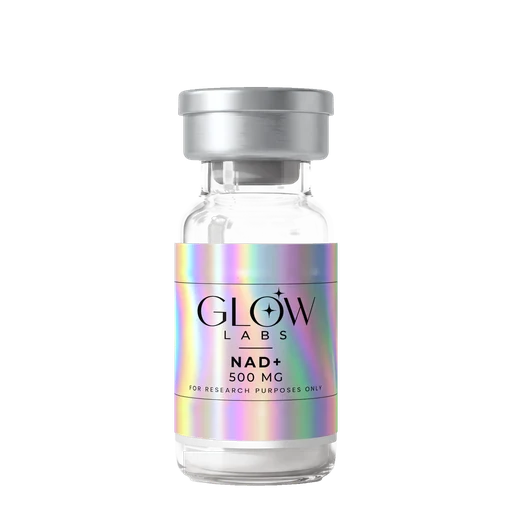
Glow Labs supplies NAD+ research vials in a 500mg size, for laboratory use only.
Sources: Covarrubias AJ et al, NAD+ metabolism and its roles in cellular processes during ageing, Nat Rev Mol Cell Biol, 2021. Xiao W et al, NAD(H) and NADP(H) redox couples and cellular energy metabolism, Antioxid Redox Signal, 2018.
Questions about this guide?
Ask on WhatsAppThe name in parts
The long name describes the parts of the molecule.
- Nicotinamide is a form of vitamin B3. It is the part that grabs and releases electrons.
- Adenine is one of the bases also found in DNA.
- Dinucleotide means two nucleotides joined together. A nucleotide is a base attached to a sugar and a phosphate group.
So NAD is two small units linked by their phosphate groups, one holding nicotinamide and one holding adenine. There are no amino acids in it at all.
Sources: Verdin E, NAD+ in aging, metabolism, and neurodegeneration, Science, 2015. PubChem, Nadide (NAD+), CID 5892, National Library of Medicine.
NAD+ vs NADH
| NAD+ | NADH | |
|---|---|---|
| State | Oxidised (empty) | Reduced (carrying electrons) |
| Main role | Accepts electrons from fuel | Delivers electrons for energy |
| Where it is busy | Glycolysis and the Krebs pathway | Electron transport in mitochondria |
| Formula | C21H27N7O14P2 | C21H29N7O14P2 |
| Molecular weight | 663.4 g/mol | 665.4 g/mol |
The two formulas differ by just two hydrogen atoms, which shows how small the change is. There is also a cousin called NADP+, which has one extra phosphate group. Cells mostly use NADP+ and NADPH for building molecules and for defence against oxidation, rather than for making energy.
Sources: Xiao W et al, NAD(H) and NADP(H) redox couples and cellular energy metabolism, Antioxid Redox Signal, 2018. PubChem, Nadide (NAD+), CID 5892, National Library of Medicine. PubChem, NADH, CID 439153, National Library of Medicine.
What NAD+ does
Carrying electrons
Cells break down sugar in steps. The first stage, glycolysis, happens in the main fluid of the cell. The next stage, the citric acid pathway (often called the Krebs pathway), runs inside mitochondria. In both, enzymes hand electrons to NAD+, making NADH. NADH then passes them on to the electron transport chain, which powers the making of ATP, the cell's energy currency.
Fuel for enzymes
NAD+ has a second job that surprised scientists. Some enzymes do not just borrow it. They break it apart and use it up. Two well known groups are the sirtuins and the PARPs. Sirtuins help control which genes are active. PARPs are part of how cells respond to DNA damage. Because these enzymes burn through NAD+, cells must keep making more.
Sources: Covarrubias AJ et al, NAD+ metabolism and its roles in cellular processes during ageing, Nat Rev Mol Cell Biol, 2021. Migaud ME et al, Regulation of and challenges in targeting NAD+ metabolism, Nat Rev Mol Cell Biol, 2024. Verdin E, NAD+ in aging, metabolism, and neurodegeneration, Science, 2015.
The NAD+ loop
Most pages list these jobs one by one. It is easier to see them as one loop with two exits.
- Supply. Vitamin B3 forms, such as nicotinamide and niacin, enter the cell and are built into NAD+.
- Energy shuttle. NAD+ picks up electrons in glycolysis and the Krebs pathway and becomes NADH.
- Return. NADH gives up its electrons in the mitochondria and becomes NAD+ again. This part of the loop repeats over and over.
- Exit one. Sirtuins split NAD+ while they adjust gene activity.
- Exit two. PARPs and the enzyme CD38 also split NAD+.
- Recycling. The nicotinamide left over is fed back into step 1. Scientists call this the salvage pathway.
The shuttle in steps 2 and 3 does not use NAD up. The exits in steps 4 and 5 do. Much research asks how cells balance the two.
Sources: Covarrubias AJ et al, NAD+ metabolism and its roles in cellular processes during ageing, Nat Rev Mol Cell Biol, 2021. Migaud ME et al, Regulation of and challenges in targeting NAD+ metabolism, Nat Rev Mol Cell Biol, 2024. Verdin E, NAD+ in aging, metabolism, and neurodegeneration, Science, 2015.
Where it comes from
Cells make NAD+ from a few starting materials, called precursors. These include the amino acid tryptophan and several forms of vitamin B3: niacin, nicotinamide, nicotinamide riboside (NR) and nicotinamide mononucleotide (NMN). Most of the NAD+ in a cell comes from recycling, not from new building.
A 2020 review of nicotinamide, one of these starting materials, explains that very large amounts can shift the balance between NAD+ and NADH and can slow sirtuins in lab studies.
Sources: Migaud ME et al, Regulation of and challenges in targeting NAD+ metabolism, Nat Rev Mol Cell Biol, 2024. Hwang ES, Song SB, Possible adverse effects of high-dose nicotinamide: mechanisms and safety assessment, Biomolecules, 2020.
Is NAD+ a peptide?
No. A peptide is a chain of amino acids. NAD+ is a dinucleotide, built from bases, sugars and phosphates. Some websites call it an "NAD peptide", but that label is wrong. Glow Labs lists it in the catalogue next to peptides only because it is a common research reagent in the same lab areas, such as work on MOTS-c and other mitochondria topics. Our MOTS-c guide covers that peptide in detail.
Ageing research
Several reviews report that NAD+ levels fall with age in some tissues of animals and people. Scientists are now asking why, and whether it matters. A 2023 review in Endocrine Reviews lists many unknowns. Labs still measure NAD+ in different ways, which makes studies hard to compare. It is unclear why precursors raise NAD+ in blood and some tissues but not in others, such as muscle. The review also says long-term safety in people is not yet established.
These are open questions. No review we read says the answers are settled.
Sources: Covarrubias AJ et al, NAD+ metabolism and its roles in cellular processes during ageing, Nat Rev Mol Cell Biol, 2021. Verdin E, NAD+ in aging, metabolism, and neurodegeneration, Science, 2015. Bhasin S et al, Nicotinamide adenine dinucleotide in aging biology: potential applications and many unknowns, Endocr Rev, 2023.
NAD+ at a glance
| Property | Value |
|---|---|
| Full name | Nicotinamide adenine dinucleotide |
| Type | Coenzyme (dinucleotide), not a peptide |
| PubChem record | CID 5892 |
| Glow Labs size | 500mg vial |
Solid NAD+ is highly hygroscopic, meaning it pulls water from the air, so research vials are kept sealed, dry and cold. Our guide on how to store peptides applies to it too. Related redox research often also looks at glutathione, a small antioxidant molecule.
Sources: PubChem, Nadide (NAD+), CID 5892, National Library of Medicine.
FAQ
What does NAD stand for?
In biology, NAD stands for nicotinamide adenine dinucleotide. In medical reports, "NAD" can also mean "no abnormality detected", which has nothing to do with the molecule.
Is NAD a peptide?
No. It contains no amino acids. It is a dinucleotide made of two linked nucleotides.
What is the difference between NAD+ and NADH?
NAD+ is the form ready to accept electrons. NADH is the form carrying them. Cells switch between the two constantly.
Is NAD like semaglutide?
No. Semaglutide is a peptide medicine that acts on a hormone receptor. NAD+ is a coenzyme found in every cell. They are a different class of molecule.
How are NAD+ research vials stored?
Sealed, dry and cold.
Sources
- Covarrubias AJ et al, NAD+ metabolism and its roles in cellular processes during ageing, Nat Rev Mol Cell Biol, 2021.
- Xiao W et al, NAD(H) and NADP(H) redox couples and cellular energy metabolism, Antioxid Redox Signal, 2018.
- Migaud ME et al, Regulation of and challenges in targeting NAD+ metabolism, Nat Rev Mol Cell Biol, 2024.
- Verdin E, NAD+ in aging, metabolism, and neurodegeneration, Science, 2015.
- Bhasin S et al, Nicotinamide adenine dinucleotide in aging biology: potential applications and many unknowns, Endocr Rev, 2023.
- Hwang ES, Song SB, Possible adverse effects of high-dose nicotinamide: mechanisms and safety assessment, Biomolecules, 2020.
- PubChem, Nadide (NAD+), CID 5892, National Library of Medicine.
- PubChem, NADH, CID 439153, National Library of Medicine.