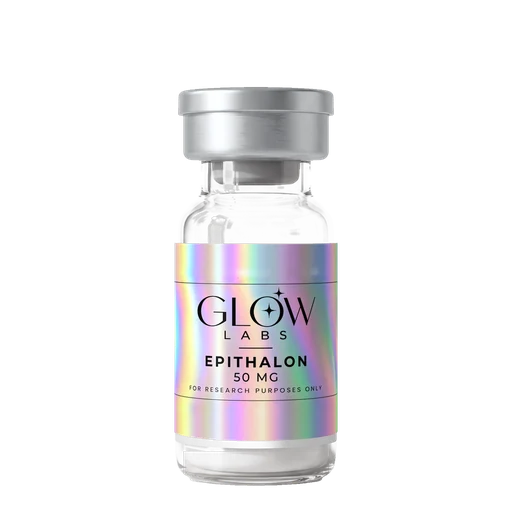
Discreet packaging
Plain outer packaging on every order.

 Research use only
Longevity research
Glutathione Australia orders from Glow Labs come as a 600mg freeze-dried research vial, not a supplement. Glutathione is a natural tripeptide of glutamate, cysteine and glycine, and it is the most plentiful small thiol made inside cells. From Gippsland we send every vial by tracked post, and it arrives in 2-3 days.
Size
$65 AUD per vial, plus $10 tracked shipping per order
Research use only. Not for human consumption.
Plain outer packaging on every order.
Orders leave Traralgon in the afternoon during business hours, then travel tracked to your door.
Certificates of analysis available on request.
If a vial arrives damaged, broken or not what you ordered, message us within 7 days with a photo and we'll replace it free.
What it is
Glutathione, often written GSH, links glutamate to cysteine through the side chain of glutamate rather than the usual backbone bond. Glycine sits at the other end.
Its working part is the sulfur atom on cysteine. That thiol group is what lets the molecule take part in redox reactions.
Sources: PubChem compound record: Glutathione (CID 124886), US National Library of Medicine. Forman HJ, Zhang H, Rinna A, Glutathione: overview of its protective roles, measurement, and biosynthesis, Mol Aspects Med, 2009.
Questions about Glutathione?
Ask on WhatsAppA widely cited 2009 review describes glutathione as the most abundant low molecular weight thiol made in cells. It covers its role in shielding cells from oxidative damage and from reactive foreign chemicals.
The same review explains how cells make glutathione, how its levels are measured in the lab, and approaches researchers have proposed for changing those levels.
Cells hold glutathione mostly in its reduced form, GSH. When two GSH molecules give up electrons they join through a sulfur bridge and form GSSG, the oxidised form.
The balance between GSH and GSSG is one of the measures researchers use to describe a cell's redox state. Our vial is labelled as glutathione, so ask us which form the certificate for our batch states. The CAS number and formula in the product specs below are for the reduced form, GSH.
Sources: PubChem compound record: Glutathione (CID 124886), US National Library of Medicine. Forman HJ, Zhang H, Rinna A, Glutathione: overview of its protective roles, measurement, and biosynthesis, Mol Aspects Med, 2009.
Bachem singles out peptides with a free cysteine as needing special care, because thiols oxidise quickly, especially above pH 7.
Keep the dry vial sealed, frozen and dark. Use oxygen free solvents for lab work and avoid holding it in solution.
Sources: Bachem, Handling and storage guidelines for peptides, Knowledge Center. JPT Peptide Technologies, How to store peptides: best practices for researchers.
Specification
| Name | Glutathione |
|---|---|
| Sizes | 600mg |
| Form | Lyophilised powder |
| Vial | 3 ml glass vial |
| Cap | Brushed silver-grey |
| CAS number | 70-18-8 |
| Formula | C10H17N3O6S |
| Molar mass | 307.33 g/mol |
| Sequence | gamma-Glu-Cys-Gly |
| Structure | A tripeptide with an unusual gamma link between glutamate and cysteine. The reduced form carries a free thiol group. |
| Storage | Keep it frozen, dry, dark and tightly sealed; the free thiol oxidises in air and moisture. |
| Certificate | On request, how to ask |
| Status | In stock |
| Use | Laboratory research only |
Sources: PubChem compound record: Glutathione (CID 124886), US National Library of Medicine. Forman HJ, Zhang H, Rinna A, Glutathione: overview of its protective roles, measurement, and biosynthesis, Mol Aspects Med, 2009. Bachem, Handling and storage guidelines for peptides, Knowledge Center. JPT Peptide Technologies, How to store peptides: best practices for researchers.
Regulatory status
The Glow Labs vial is a research chemical for laboratory use only. It is not a supplement, a cosmetic or a medicine.
Australia's Poisons Standard has a single glutathione entry. It places glutathione for parenteral use, meaning any route that bypasses the gut, in Schedule 4 with the prescription only medicines.
Testing
Certificates of analysis are available on request. Ask us on WhatsApp before or after you order.
How ordering works
Add compounds and quantities. No account needed.
One tap writes your whole order into a WhatsApp message.
We confirm stock and your total, share payment details, then ship tracked.
FAQ
Yes. It is a tripeptide made of glutamate, cysteine and glycine.
NAC, N-acetylcysteine, is a modified single amino acid. Glutathione is a three residue peptide that contains cysteine.
Keep the sealed vial frozen, dry and dark. Let it reach room temperature before opening so moisture does not condense, then reseal quickly. Its cysteine thiol oxidises in air, faster in solution above pH 7.
Sources: PubChem compound record: Glutathione (CID 124886), US National Library of Medicine. Forman HJ, Zhang H, Rinna A, Glutathione: overview of its protective roles, measurement, and biosynthesis, Mol Aspects Med, 2009. Bachem, Handling and storage guidelines for peptides, Knowledge Center. JPT Peptide Technologies, How to store peptides: best practices for researchers. PubChem compound record: N-Acetyl-L-Cysteine (CID 12035, C5H9NO3S), US National Library of Medicine.
In the catalogue
Questions before you order?
Ask on WhatsApp