What is MOTS-c?
Mitochondria are the small structures inside cells that turn food into usable energy. They carry a tiny loop of their own DNA, separate from the main set of genes in the nucleus. In 2015 a research team found a short stretch of that loop that holds the recipe for a 16 amino acid peptide. They named it MOTS-c.
Scientists call it a mitochondrial-derived peptide, or MDP. Humanin was the first one found. MOTS-c came next, and it is now one of the most studied in the group.
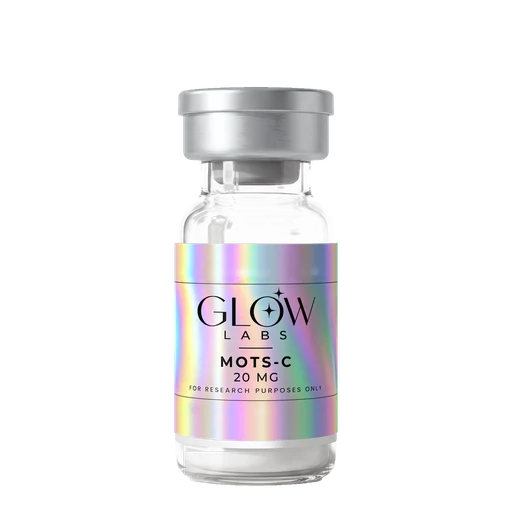
Glow Labs stocks MOTS-c research vials in 10mg and 20mg sizes, for laboratory use only.
Sources: Lee C et al, The mitochondrial-derived peptide MOTS-c promotes metabolic homeostasis and reduces obesity and insulin resistance, Cell Metab, 2015. Mohtashami Z et al, MOTS-c, the most recent mitochondrial derived peptide in human aging and age-related diseases, Int J Mol Sci, 2022.
Questions about this guide?
Ask on WhatsAppWhat the name means
Spelled out, MOTS-c is the mitochondrial ORF of the 12S rRNA, type c, where ORF means open reading frame. That is a mouthful, so here it is in plain words:
- Mitochondrial means the gene sits in mitochondrial DNA.
- Open reading frame is a stretch of DNA that a cell can read to build a peptide or protein.
- 12S rRNA is the name of the mitochondrial gene where this stretch was found. It mainly helps build the cell's protein-making machinery.
- Type-c marks it as one of several short frames the team looked at.
So the name is really an address. It tells you where in the DNA the peptide comes from.
Sources: Lee C et al, The mitochondrial-derived peptide MOTS-c promotes metabolic homeostasis and reduces obesity and insulin resistance, Cell Metab, 2015. Benayoun BA, Lee C, MOTS-c: A mitochondrial-encoded regulator of the nucleus, Bioessays, 2019.
Why it is unusual
Most peptide hormones are coded in the nucleus. They are made in the cell and often sent out to act on other cells. MOTS-c flips the usual direction. A 2019 review describes how it can move from the cytoplasm into the nucleus when a cell is under metabolic stress, such as low sugar. Once inside, it was found to affect which nuclear genes switch on.
This matters to researchers because it suggests mitochondria can send messages back to the nucleus with a peptide of their own. It is still an early idea, built mainly on cell work.
Sources: Benayoun BA, Lee C, MOTS-c: A mitochondrial-encoded regulator of the nucleus, Bioessays, 2019.
What was studied
Cell and mouse studies
The 2015 discovery paper worked mostly in cells and mice. It reported that MOTS-c acts in skeletal muscle and affects the folate pathway, which led to activation of an energy sensor called AMPK. The team then measured insulin response in mice on a high-fat diet and in older mice.
A 2021 paper in Nature Communications tested MOTS-c in young, middle-aged and old mice and measured physical performance on running tests. It also looked at muscle genes and how muscle cells handle metabolic stress.
Human studies so far
The same 2021 paper took blood and muscle samples from people at rest and again after exercise. It found that natural MOTS-c levels rose with exercise. That is an observation about the body's own peptide. Nobody was given MOTS-c in that work.
We also searched ClinicalTrials.gov on 26 October 2026. It listed five registered studies. One, NCT07505745, is a Phase 2 trial first posted on 1 April 2026 that gives MOTS-c against a placebo. It is still recruiting and has posted no findings. Three others measure MOTS-c in blood as one marker among several. Two are in people with type 2 diabetes, and one is in people having a kidney transplant. The fifth is a newborn hearing screen that tests a mitochondrial gene and does not name MOTS-c.
Sources: Lee C et al, The mitochondrial-derived peptide MOTS-c promotes metabolic homeostasis and reduces obesity and insulin resistance, Cell Metab, 2015. Reynolds JC et al, MOTS-c is an exercise-induced mitochondrial-encoded regulator of age-dependent physical decline and muscle homeostasis, Nat Commun, 2021. ClinicalTrials.gov search for MOTS-c, run 26 October 2026 (5 registered studies). ClinicalTrials.gov, Study record NCT07505745, read 26 October 2026.
Evidence ladder
Many pages talk about MOTS-c as if its uses were proven. This table puts each topic next to the strongest type of evidence that actually exists.
| Topic | Cell studies | Mouse studies | Human data | Approved medicine |
|---|---|---|---|---|
| Metabolism and insulin response | Yes | Yes | Levels measured; one trial recruiting, no findings yet | None |
| Exercise and muscle | Yes | Yes | Levels rise after exercise | None |
| Ageing biology | Yes | Yes, older mice | Levels compared by age | None |
| Signalling to the nucleus | Yes | Limited | None | None |
Reviews from 2022 and 2023 describe MOTS-c as a candidate for future study, not as a finished drug.
Sources: Lee C et al, The mitochondrial-derived peptide MOTS-c promotes metabolic homeostasis and reduces obesity and insulin resistance, Cell Metab, 2015. Benayoun BA, Lee C, MOTS-c: A mitochondrial-encoded regulator of the nucleus, Bioessays, 2019. Reynolds JC et al, MOTS-c is an exercise-induced mitochondrial-encoded regulator of age-dependent physical decline and muscle homeostasis, Nat Commun, 2021. Zheng Y et al, MOTS-c: A promising mitochondrial-derived peptide for therapeutic exploitation, Front Endocrinol, 2023. Mohtashami Z et al, MOTS-c, the most recent mitochondrial derived peptide in human aging and age-related diseases, Int J Mol Sci, 2022. ClinicalTrials.gov, Study record NCT07505745, read 26 October 2026.
Structure
| Property | Value |
|---|---|
| Length | 16 amino acids |
| Coded in | Mitochondrial DNA, 12S rRNA region |
| Formula | C101H152N28O22S2 |
| Molecular weight | 2174.6 g/mol |
| PubChem record | CID 146675088 |
| Supplied as | lyophilised powder |
Sources: Lee C et al, The mitochondrial-derived peptide MOTS-c promotes metabolic homeostasis and reduces obesity and insulin resistance, Cell Metab, 2015. PubChem, Mots-c, CID 146675088, National Library of Medicine.
Sport and the law
MOTS-c is named on the 2026 World Anti-Doping Agency Prohibited List, in the group for activators of AMPK (class S4.4.1). Substances in that group are banned at all times, in and out of competition. Sport Integrity Australia also names MOTS-c on its peptides page.
We did not find MOTS-c registered as a medicine anywhere. It is sold here strictly as a lab reagent.
Sources: World Anti-Doping Agency, 2026 Prohibited List, S4.4.1 activators of AMPK, in force 1 January 2026, read 26 October 2026. Sport Integrity Australia, Peptides explained, read 26 October 2026.
Storing vials
MOTS-c arrives as a freeze-dried powder. Like other lyophilised peptides, it keeps best cold, dry and away from light, with the cap sealed. Once mixed with water, peptides break down faster. Our guide on how to store peptides covers fridge and freezer choices in detail.
Sources: Bachem, Handling and storage guidelines for peptides, Knowledge Center. Kerwin BA, Remmele RL, Protect from light: photodegradation and protein biologics, J Pharm Sci, 2007.
Not C-peptide
People often mix these up in search. C-peptide is a string of amino acids the pancreas makes while it makes insulin. Doctors sometimes measure it in blood or urine tests. MOTS-c is a different molecule from a different source, the mitochondria. The two share nothing but a letter.
Sources: Lee C et al, The mitochondrial-derived peptide MOTS-c promotes metabolic homeostasis and reduces obesity and insulin resistance, Cell Metab, 2015. MedlinePlus, C-Peptide Test, National Library of Medicine, read 26 October 2026.
Related compounds
MOTS-c sits in a small group of research compounds linked to mitochondria. SS-31 is another research peptide studied for its link to mitochondria. NAD+ is a coenzyme, not a peptide, and our guide what is NAD explains how it works in energy pathways. SLU-PP-332 is a small molecule also studied around exercise, and our SLU-PP-332 guide explains why it is not a peptide at all.
Sources: Szeto HH, First-in-class cardiolipin-protective compound as a therapeutic agent to restore mitochondrial bioenergetics, Br J Pharmacol, 2014. Xiao W et al, NAD(H) and NADP(H) redox couples and cellular energy metabolism, Antioxid Redox Signal, 2018. Billon C et al, Synthetic ERRalpha/beta/gamma agonist induces an ERRalpha-dependent acute aerobic exercise response and enhances exercise capacity, ACS Chem Biol, 2023.
FAQ
What is MOTS-c peptide?
It is a short chain of 16 amino acids built from a gene in mitochondrial DNA. Scientists first reported it in 2015 and group it with humanin as a mitochondrial-derived peptide. Most research on it so far is in cells and mice.
Is MOTS-c a peptide or a hormone?
It is a peptide. Some researchers call it a mitokine or a mitochondrial hormone, because it may send signals to other parts of the cell and body. Those labels are research ideas, not settled terms.
Is MOTS-c banned in sport?
Yes. The World Anti-Doping Agency lists it as prohibited at all times. Sport Integrity Australia names it in its peptide guidance.
Has MOTS-c been tested in people?
One registered Phase 2 trial is testing MOTS-c in people and has posted no findings yet. Other human studies measure the body's own MOTS-c levels, for example after exercise.
What sizes does Glow Labs stock?
MOTS-c is listed in 10mg and 20mg vials, both as lyophilised powder for laboratory research.
Sources
- Lee C et al, The mitochondrial-derived peptide MOTS-c promotes metabolic homeostasis and reduces obesity and insulin resistance, Cell Metab, 2015.
- Benayoun BA, Lee C, MOTS-c: A mitochondrial-encoded regulator of the nucleus, Bioessays, 2019.
- Reynolds JC et al, MOTS-c is an exercise-induced mitochondrial-encoded regulator of age-dependent physical decline and muscle homeostasis, Nat Commun, 2021.
- Zheng Y et al, MOTS-c: A promising mitochondrial-derived peptide for therapeutic exploitation, Front Endocrinol, 2023.
- Mohtashami Z et al, MOTS-c, the most recent mitochondrial derived peptide in human aging and age-related diseases, Int J Mol Sci, 2022.
- PubChem, Mots-c, CID 146675088, National Library of Medicine.
- World Anti-Doping Agency, 2026 Prohibited List, S4.4.1 activators of AMPK, in force 1 January 2026, read 26 October 2026.
- Sport Integrity Australia, Peptides explained, read 26 October 2026.
- ClinicalTrials.gov search for MOTS-c, run 26 October 2026 (5 registered studies).
- ClinicalTrials.gov, Study record NCT07505745, read 26 October 2026.
- Bachem, Handling and storage guidelines for peptides, Knowledge Center.
- Kerwin BA, Remmele RL, Protect from light: photodegradation and protein biologics, J Pharm Sci, 2007.
- MedlinePlus, C-Peptide Test, National Library of Medicine, read 26 October 2026.
- Szeto HH, First-in-class cardiolipin-protective compound as a therapeutic agent to restore mitochondrial bioenergetics, Br J Pharmacol, 2014.
- Xiao W et al, NAD(H) and NADP(H) redox couples and cellular energy metabolism, Antioxid Redox Signal, 2018.
- Billon C et al, Synthetic ERRalpha/beta/gamma agonist induces an ERRalpha-dependent acute aerobic exercise response and enhances exercise capacity, ACS Chem Biol, 2023.