Peptides in brief
The TGA describes peptides as short chains of amino acids, the building blocks of proteins, and notes that they can mimic or stimulate natural processes in the body, such as those involved in growth and metabolism. Sport Integrity Australia adds that peptides are found in abundance throughout nature and play a key role in many biological processes.
Three facts cover most of what you need:
- A peptide is a chain of amino acids, usually short.
- The order of the amino acids, called the sequence, decides what the peptide is and what it does.
- Peptides can be natural or made in a lab, and lab-made peptides can copy natural ones exactly or be changed on purpose.
In Australia, the TGA regulates peptide products as therapeutic goods. Some, such as insulin products, are approved medicines on the Australian Register of Therapeutic Goods (ARTG). Others are not approved and have not been assessed by the TGA.
Sources: Therapeutic Goods Administration, Understanding your responsibilities when importing, compounding and supplying unapproved peptide products, Safety advisory, 13 April 2026. Sport Integrity Australia, Peptides explained, Substance education.
Questions about this guide?
Ask on WhatsAppThe peptide bond
There are 20 common amino acids in living things. Each one has the same two "hands": an amino group on one end and an acid group on the other. What makes each amino acid different is its side chain.
When two amino acids join, the acid end of one links to the amino end of the next. A molecule of water is released as they join. The new link is called a peptide bond. Repeat the process and you get a chain.
The ladder below shows how chain length grows, using real examples.
| Chain length | Name | Real example |
|---|---|---|
| 1 | Amino acid | Glycine on its own |
| 2 | Dipeptide | Two amino acids, one peptide bond |
| 3 | Tripeptide | Glutathione: glutamate, cysteine and glycine |
| 9 | Short peptide hormone | Oxytocin |
| 51 | Peptide hormone, or small protein | Insulin: two chains of 30 and 21 amino acids |
| Hundreds or more | Protein | Large chains that fold into complex shapes |
Sources: PubChem compound record: Glutathione (CID 124886), US National Library of Medicine. PubChem compound record: Oxytocin (CID 439302), US National Library of Medicine. UniProt entry P01308: Insulin, human (B chain 30 and A chain 21 amino acids).
Peptides vs proteins
There is no sharp line between a peptide and a protein. Both are chains of amino acids joined by the same bond. The difference is mostly size and shape.
- Peptides are short. Many have a simple, flexible shape or none at all.
- Proteins are long. They fold into detailed three-dimensional shapes, and some are made of several chains held together.
Insulin sits right on the border. It is often called a peptide hormone, and both the TGA and Sport Integrity Australia use it as their main example of a peptide medicine, yet it has two chains and a folded shape like a small protein. The words describe a range, not two boxes.
Sources: Therapeutic Goods Administration, Understanding your responsibilities when importing, compounding and supplying unapproved peptide products, Safety advisory, 13 April 2026. Sport Integrity Australia, Peptides explained, Substance education. UniProt entry P01308: Insulin, human (B chain 30 and A chain 21 amino acids).
Made by the body
Many of the body's signals are peptides. They are made in one place, travel or diffuse to another, and attach to receptors that switch a process on or off.
- Hormones: insulin, made in the pancreas, and oxytocin, made in the brain, are both peptides.
- Brain signals: many messengers between nerve cells, called neuropeptides, are short chains.
- Defence: antimicrobial peptides are part of the defence system of plants, animals and microbes. A 2021 review notes they are found across all kingdoms of life and are mostly short, positively charged chains.
- Housekeeping: glutathione, a three amino acid peptide, is studied for its part in how cells handle oxidation.
Sources: Sport Integrity Australia, Peptides explained, Substance education. PubChem compound record: Oxytocin (CID 439302), US National Library of Medicine. Bin Hafeez A et al, Antimicrobial peptides: an update on classifications and databases, Int J Mol Sci, 2021.
Food and microbes
Peptides are not only made inside the body. When proteins in food are broken down, shorter fragments are released, and food scientists study these for their biological activity. Microbes, plants and venomous animals also make peptides, and many of today's research tools began as natural peptides found in nature.
A 2022 editorial in the International Journal of Molecular Sciences summed up why the field is busy: peptides are attracting interest in medicine, food science and cosmetics at the same time. A 2021 review of peptide drug discovery describes how researchers now screen animal venoms and large peptide libraries for new candidates.
Sources: Muttenthaler M et al, Trends in peptide drug discovery, Nat Rev Drug Discov, 2021. Bin Hafeez A et al, Antimicrobial peptides: an update on classifications and databases, Int J Mol Sci, 2021. Martínez-Villaluenga C, Hernández-Ledesma B, Peptides for health benefits 2020 (editorial), Int J Mol Sci, 2022.
Peptide medicines
Peptides have a long history in medicine. Sport Integrity Australia notes that insulin was one of the first peptides to be isolated, in 1921, and is still used to manage diabetes today.
The numbers have grown since. A 2021 review counted more than 80 peptide drugs on the market, for conditions including diabetes, cancer and osteoporosis. A 2018 review listed over 150 peptides in active clinical development at the time.
Newer examples include the GLP-1 medicines. Semaglutide, a GLP-1 medicine, is a peptide. So are many of the newest compounds in clinical trials.
A research peptide is not the same as an approved medicine, even when the molecule has the same name. Unapproved peptide products have had no TGA assessment of their safety, quality or effectiveness, the regulator says. A 2024 study that test-bought semaglutide sold online without a prescription found quality and safety problems, including endotoxin in every vial it tested.
Sources: Therapeutic Goods Administration, Understanding your responsibilities when importing, compounding and supplying unapproved peptide products, Safety advisory, 13 April 2026. Muttenthaler M et al, Trends in peptide drug discovery, Nat Rev Drug Discov, 2021. Lau JL, Dunn MK, Therapeutic peptides: historical perspectives, current development trends, and future directions, Bioorg Med Chem, 2018. Sport Integrity Australia, Peptides explained, Substance education. Ashraf AR et al, J Med Internet Res, 2024.
Uses in research
So what are peptides used for in research? The answer is fields of study, not personal use. Researchers use peptides to ask questions about how living systems work.
| Research field | What peptides help study |
|---|---|
| Drug discovery | Natural and designed peptides are screened as starting points for new medicines |
| Cell signalling | Peptides that match natural hormones let scientists study receptors one at a time |
| Cell entry | Cell-penetrating peptides are short chains that can cross cell membranes, studied as carriers for other molecules |
| Microbiology | Antimicrobial peptides are studied as a response to drug-resistant bacteria |
| Cosmetic chemistry | Small peptides are studied as skincare ingredients, and a 2009 review grouped them by how they were thought to act |
| Analytical chemistry | Peptides are standards for testing methods such as HPLC and mass spectrometry |
None of these is a claim about what a peptide does for a person. They are areas where peptides are a research tool.
Sources: Muttenthaler M et al, Trends in peptide drug discovery, Nat Rev Drug Discov, 2021. Bin Hafeez A et al, Antimicrobial peptides: an update on classifications and databases, Int J Mol Sci, 2021. Guidotti G et al, Cell-penetrating peptides: from basic research to clinics, Trends Pharmacol Sci, 2017. Gorouhi F, Maibach HI, Role of topical peptides in preventing or treating aged skin, Int J Cosmet Sci, 2009.
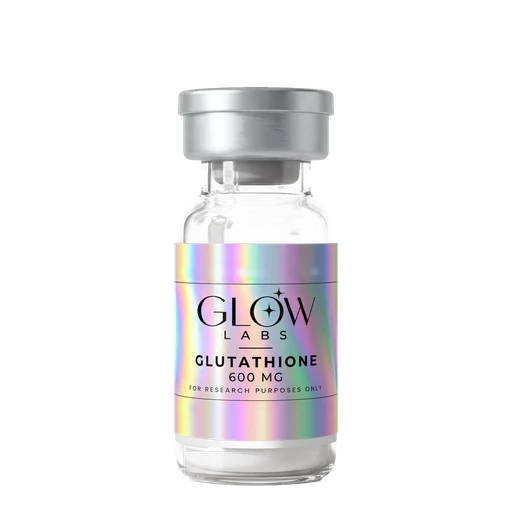
Why a powder vial?
Research peptides are almost always sold as a freeze-dried powder in a sealed glass vial. Taking the water out slows the chemistry that ages a peptide, so the dry form keeps far longer. The powder is dissolved only when it is needed. Our guide to lyophilized peptide powder explains how freeze-drying works, and our peptide purity guide covers how labs check what is in a vial.
Glow Labs sells its peptides for laboratory research only. Each order goes out tracked from Gippsland in Victoria, with delivery in 2-3 days. You can browse every compound in our research peptide catalogue.
Sources: Lai MC et al, Solid-state chemical stability of proteins and peptides, J Pharm Sci, 1999.
FAQ
Is a peptide a protein?
Not quite. Both are chains of amino acids, but peptides are shorter and simpler. Long chains that fold into complex shapes are called proteins. Insulin, at 51 amino acids, sits on the border.
Is semaglutide a peptide?
Yes. Semaglutide is a GLP-1 receptor agonist built from a peptide chain.
Are peptides steroids?
No. Peptides are chains of amino acids. Steroids are a different family of molecules. They are made differently and work differently.
Are peptides legal in Australia?
The TGA regulates peptide products as therapeutic goods. Approved ones are on the ARTG. The TGA says unapproved peptide products have not been assessed, and that advertising them is likely to breach Australian therapeutic goods advertising laws. The TGA has also said that a research use only label, on its own, does not make it legal to supply an unapproved peptide. Our research use only page explains how Glow Labs sells its compounds.
Sources: Therapeutic Goods Administration, Understanding your responsibilities when importing, compounding and supplying unapproved peptide products, Safety advisory, 13 April 2026. Sport Integrity Australia, Peptides explained, Substance education. Ashraf AR et al, J Med Internet Res, 2024.
Sources
- Therapeutic Goods Administration, Understanding your responsibilities when importing, compounding and supplying unapproved peptide products, Safety advisory, 13 April 2026.
- Muttenthaler M et al, Trends in peptide drug discovery, Nat Rev Drug Discov, 2021.
- Lau JL, Dunn MK, Therapeutic peptides: historical perspectives, current development trends, and future directions, Bioorg Med Chem, 2018.
- Sport Integrity Australia, Peptides explained, Substance education.
- PubChem compound record: Glutathione (CID 124886), US National Library of Medicine.
- PubChem compound record: Oxytocin (CID 439302), US National Library of Medicine.
- UniProt entry P01308: Insulin, human (B chain 30 and A chain 21 amino acids).
- Bin Hafeez A et al, Antimicrobial peptides: an update on classifications and databases, Int J Mol Sci, 2021.
- Martínez-Villaluenga C, Hernández-Ledesma B, Peptides for health benefits 2020 (editorial), Int J Mol Sci, 2022.
- Guidotti G et al, Cell-penetrating peptides: from basic research to clinics, Trends Pharmacol Sci, 2017.
- Gorouhi F, Maibach HI, Role of topical peptides in preventing or treating aged skin, Int J Cosmet Sci, 2009.
- Lai MC et al, Solid-state chemical stability of proteins and peptides, J Pharm Sci, 1999.
- Ashraf AR et al, J Med Internet Res, 2024.