The short answer
Glutathione is not a nutrient you must eat, because cells make it from parts they already have. It is not a hormone either. It works inside cells as a chemical buffer and as a partner for several enzymes.
| Fact | Detail |
|---|---|
| Formula | C10H17N3O6S |
| Molar mass | about 307 g/mol |
| PubChem record | CID 124886 |
| Short names | GSH (reduced), GSSG (oxidised) |
| Natural form | L-glutathione |
"L-glutathione" simply names the natural mirror-image form, the one cells make. The "l" in "l glutathione" names this same natural form.
Sources: PubChem compound record CID 124886 (glutathione), US National Library of Medicine. Lu SC, Glutathione synthesis, Biochim Biophys Acta, 2013. US National Library of Medicine, MeSH descriptor: Glutathione (D005978).
Questions about this guide?
Ask on WhatsAppThree building blocks
Picture glutathione as three beads on a short string:
| Position | Amino acid | How it joins the next bead |
|---|---|---|
| 1 | glutamate (glutamic acid) | through its side chain, the gamma link |
| 2 | cysteine | an ordinary peptide bond |
| 3 | glycine | end of the chain |
The first link is the unusual part. In a normal peptide, each amino acid joins the next through its main backbone. In glutathione, glutamate attaches through its side chain instead. That is why papers write it as gamma-glutamyl-cysteinyl-glycine.
Glutamate is easy to confuse with glutamine, which is a different amino acid. The middle bead, cysteine, carries the sulfur group that does most of the chemical work.
Sources: PubChem compound record CID 124886 (glutathione), US National Library of Medicine. Lu SC, Glutathione synthesis, Biochim Biophys Acta, 2013.
GSH and GSSG
Glutathione switches between two forms as it gives and takes electrons.
| Form | What it is | What changes |
|---|---|---|
| GSH, reduced | one glutathione molecule with a free sulfur group | ready to react |
| GSSG, oxidised | two glutathione molecules linked by a bond between their cysteine sulfur atoms | formed as it is used up |
Because the balance between the two shifts with conditions in the cell, researchers often treat glutathione as a marker of a cell's redox state. In lab terms, the ratio of oxidised to reduced glutathione is one of the numbers they report.
Sources: Vašková J et al, Glutathione-related enzymes and proteins: a review, Molecules, 2023. US National Library of Medicine, MeSH descriptor: Glutathione Disulfide (D019803).
How cells make it
Glutathione is built in the cytosol, the fluid part of the cell, in two enzyme steps.
- Glutamate cysteine ligase joins glutamate to cysteine. This is the slow, rate-limiting step, and the enzyme has two parts: a catalytic subunit and a modifier subunit.
- Glutathione synthetase adds glycine to finish the chain.
How much a cell can make depends mostly on two things: how much cysteine it has on hand, and how active that first enzyme is. A 2013 review explains that several control proteins switch these genes up or down. A 2023 review adds that the liver plays a central role in moving glutathione between organs.
Sources: Lu SC, Glutathione synthesis, Biochim Biophys Acta, 2013. Vašková J et al, Glutathione-related enzymes and proteins: a review, Molecules, 2023.
What it does in cells
The roles below describe biochemistry, not anything glutathione does for a person.
- Redox buffer. Its free sulfur group reacts with oxidising molecules, which is where the antioxidant label comes from.
- Partner to peroxidases. Enzymes called glutathione peroxidases use it to break down peroxides.
- Conjugation. Enzymes called glutathione S-transferases attach it to foreign chemicals so they dissolve in water and can leave the body.
- Disulfide repair. Through enzymes called glutaredoxins, it helps rearrange sulfur bonds in proteins.
- Enzyme cofactor. Some enzymes need it to work at all.
Sources: Lu SC, Glutathione synthesis, Biochim Biophys Acta, 2013. Vašková J et al, Glutathione-related enzymes and proteins: a review, Molecules, 2023. US National Library of Medicine, MeSH descriptor: Glutathione (D005978).
How it is measured
Researchers measure glutathione in the lab. A 2015 trial at a US university gives a good picture of where researchers look. It measured glutathione in whole blood, red blood cells, plasma, white blood cells called lymphocytes, and cells gently scraped from the inside of the cheek. It also tracked the oxidised to reduced ratio in whole blood.
We cite that trial only for its methods. Its findings are about supplements in people, which this guide does not cover.
Glutathione in food
Glutathione is present in many foods. A 1992 study tested the foods on a large US diet questionnaire. It used liquid chromatography to measure them. Meat that had just been cooked tended to carry the most, while milk products, cereals and bread usually carried little. Fruit and vegetables sat in between or higher. Freezing kept levels close to fresh, but other kinds of processing caused large losses.
This is food chemistry data, and we do not draw any diet advice from it.
A short history
The British biochemist Frederick Gowland Hopkins described glutathione in a 1921 paper as a substance in cells that reacts readily with oxygen. A year later, he and Malcolm Dixon published a follow-up treating it as an oxidation-reduction system that survives heat. The Journal of Biological Chemistry later reprinted that 1922 paper as one of its classics.
Sources: Hopkins FG, On an autoxidisable constituent of the cell, Biochem J, 1921. Simoni RD, Hill RL, Vaughan M, J Biol Chem, 2002.
Vial, capsule or drip
The same molecule turns up in three very different products, and it helps to keep them apart.
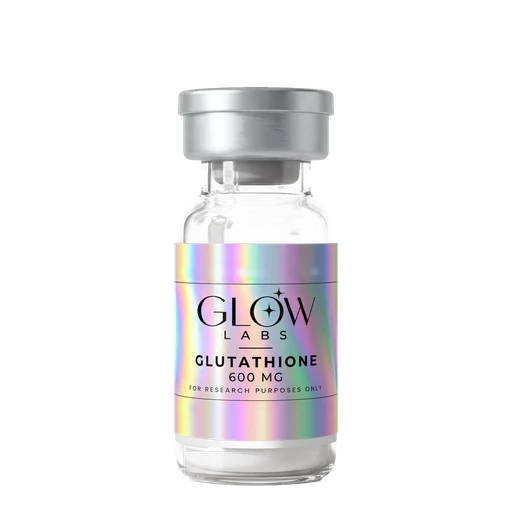
- A research vial holds lyophilised glutathione for laboratory work.
- A capsule is a supplement product, sold under different rules.
- A drip clinic product is given by clinic staff, again under different rules.
Glow Labs supplies only the first. Our glutathione research vials are freeze-dried powder, research use only, and are not a supplement or a medicine. For keeping the powder stable, see how lyophilised peptides are stored. Glutathione sits in our longevity research area next to NAD+, a coenzyme that also moves electrons around cells; our guide on what NAD+ is covers it. For where glutathione fits among other kinds of peptides, see our classification guide.
In Australia, glutathione for parenteral use (given by a route other than the gut, such as a drip) is a Schedule 4 entry in the Poisons Standard. The glutathione vial page carries the full regulatory note.
Our vials leave Gippsland in Victoria, tracked, with delivery in 2-3 days.
FAQ
What is L-glutathione?
It is the natural form of glutathione, the one cells make. The "L" names its mirror-image shape, not a different compound.
What does glutathione do?
In cell chemistry it acts as a redox buffer, a partner to peroxidase and S-transferase enzymes, and a cofactor. These describe biochemistry, not a health effect.
Is glutathione a peptide?
Yes. It is a tripeptide of glutamate, cysteine and glycine, with an unusual side chain link between the first two.
What food is highest in glutathione?
In a 1992 study of US foods, freshly prepared meats were relatively high, fruit and vegetables moderate to high, and dairy, cereals and breads generally low.
Is there a test for low glutathione?
Research labs measure it in blood cells, plasma and cheek cells. We cannot advise on testing; a registered health professional can.
Sources: PubChem compound record CID 124886 (glutathione), US National Library of Medicine. Vašková J et al, Glutathione-related enzymes and proteins: a review, Molecules, 2023. Richie JP Jr et al, Randomized controlled trial of oral glutathione supplementation on body stores of glutathione, Eur J Nutr, 2015. Jones DP et al, Glutathione in foods listed in the National Cancer Institute's Health Habits and History Food Frequency Questionnaire, Nutr Cancer, 1992.
Sources
- PubChem compound record CID 124886 (glutathione), US National Library of Medicine.
- Lu SC, Glutathione synthesis, Biochim Biophys Acta, 2013.
- Vašková J et al, Glutathione-related enzymes and proteins: a review, Molecules, 2023.
- Richie JP Jr et al, Randomized controlled trial of oral glutathione supplementation on body stores of glutathione, Eur J Nutr, 2015.
- Jones DP et al, Glutathione in foods listed in the National Cancer Institute's Health Habits and History Food Frequency Questionnaire, Nutr Cancer, 1992.
- Hopkins FG, On an autoxidisable constituent of the cell, Biochem J, 1921.
- Simoni RD, Hill RL, Vaughan M, J Biol Chem, 2002.
- US National Library of Medicine, MeSH descriptor: Glutathione (D005978).
- US National Library of Medicine, MeSH descriptor: Glutathione Disulfide (D019803).
- Therapeutic Goods (Poisons Standard, October 2026) Instrument 2026 (F2026L01327): Schedule 4 entry, glutathione for parenteral use, Federal Register of Legislation, Australian Government.