The short answer
Both are tripeptides, chains of three amino acids, bound to copper(II). GHK is found naturally in human plasma. AHK is a lab made variant that is not described as a natural compound in the papers we checked.
When we searched PubMed on 25 October 2026, AHK-Cu appeared in the title or abstract of one paper. GHK with copper appeared in 92.
Sources: PubChem compound record CID 73587 (glycyl-L-histidyl-L-lysine, GHK), US National Library of Medicine. PubChem compound record CID 7408502 (L-alanyl-L-histidyl-L-lysine, AHK), US National Library of Medicine. Pickart L et al, J Cell Physiol, 1980. Glow Labs PubMed search, GHK[tiab] AND copper[tiab] (title and abstract), 25 October 2026: 92 records. Glow Labs PubMed search, AHK-Cu[tiab], 25 October 2026: 1 record.
Questions about this guide?
Ask on WhatsAppStructures compared
Alanine has one extra carbon group compared with glycine. That small change shows up in the formula and weight.
| Property | GHK | AHK |
|---|---|---|
| Sequence | Gly-His-Lys | Ala-His-Lys |
| Peptide formula | C14H24N6O4 | C15H26N6O4 |
| Peptide weight | 340.38 g/mol | 354.41 g/mol |
| Peptide PubChem CID | 73587 | 7408502 |
| Copper complex record | CID 139035031, C14H21CuN6O4- (an anion in PubChem), 400.90 g/mol | CID 168431292, a hydrochloride salt record, 451.39 g/mol |
Note that the AHK copper record in PubChem includes chloride, so its weight is not directly comparable with the GHK-Cu record. A batch certificate should state which form a vial holds.
Sources: PubChem compound record CID 73587 (glycyl-L-histidyl-L-lysine, GHK), US National Library of Medicine. PubChem compound record CID 7408502 (L-alanyl-L-histidyl-L-lysine, AHK), US National Library of Medicine. PubChem compound record CID 139035031 (copper tripeptide, GHK-Cu), US National Library of Medicine. PubChem compound record CID 168431292 (AHK copper complex, hydrochloride record), US National Library of Medicine.
Origins
Loren Pickart first linked GHK to copper in human plasma in a 1980 paper. Later work from his group described it as a natural tripeptide that carries copper and that falls in level with age.
AHK-Cu has no such history. It appears in the literature as a synthetic copper tripeptide tested in a lab study, built on the same idea as GHK-Cu.
Sources: Pyo HK et al, The effect of tripeptide-copper complex on human hair growth in vitro, Arch Pharm Res, 2007. Pickart L et al, J Cell Physiol, 1980. Pickart L et al, GHK Peptide as a Natural Modulator of Multiple Cellular Pathways in Skin Regeneration, Biomed Res Int, 2015.
Research volume
This table is our own count, not a quote from anyone else. It uses PubMed title and abstract searches run on 25 October 2026. Counts change as new papers are indexed.
| Search | Records |
|---|---|
| GHK-Cu in title or abstract | 83 |
| GHK and copper in title or abstract | 92 |
| of those, tagged as reviews | 8 |
| of those, tagged as clinical trials | 1 |
| of those, animal only | 16 |
| AHK-Cu in title or abstract | 1 |
| AHK and copper in title or abstract | 1 |
So "GHK-Cu is better studied" is not just a claim. On these searches it has about 92 times as many records. Even so, only one GHK paper is tagged as a clinical trial.
Sources: Glow Labs PubMed search, GHK-Cu[tiab], 25 October 2026: 83 records. Glow Labs PubMed search, GHK[tiab] AND copper[tiab] (title and abstract), 25 October 2026: 92 records. Glow Labs PubMed search, GHK[tiab] AND copper[tiab] AND review[pt], 25 October 2026: 8 records. Glow Labs PubMed search, GHK[tiab] AND copper[tiab] AND clinical trial[pt], 25 October 2026: 1 record. Glow Labs PubMed search, GHK[tiab] AND copper[tiab] AND (animals[mh] NOT humans[mh]), 25 October 2026: 16 records. Glow Labs PubMed search, AHK-Cu[tiab], 25 October 2026: 1 record. Glow Labs PubMed search, AHK[tiab] AND copper[tiab], 25 October 2026: 1 record.
GHK-Cu studies
The GHK record covers how it binds copper, how it affects collagen made by skin cells in dishes, gene expression work in cell lines, and wound models in several animals. A 2020 modelling study mapped the copper bond in detail. A 2026 review graded the human evidence as sparse.
The AHK-Cu study
The single AHK-Cu paper is from Seoul National University, published in 2007. Researchers kept human hair follicles alive in a dish, and also grew dermal papilla cells, which sit at the base of a follicle. They found that very low concentrations of AHK-Cu lengthened the follicles in the dish and increased cell growth. A drop in cell death was seen but was not statistically significant.
No animal or human study of AHK-Cu turned up in our searches. Some web pages cite this 2007 paper as evidence for GHK-Cu, which is a mistake: the abstract is about AHK-Cu.
Sources: Pyo HK et al, The effect of tripeptide-copper complex on human hair growth in vitro, Arch Pharm Res, 2007. Pickart L, The human tri-peptide GHK and tissue remodeling, J Biomater Sci Polym Ed, 2008. Pickart L et al, GHK Peptide as a Natural Modulator of Multiple Cellular Pathways in Skin Regeneration, Biomed Res Int, 2015. Alshammari N, Platts JA, Theoretical study of copper binding to GHK peptide, Comput Biol Chem, 2020. Mateescu DM et al, Pharmaceutics, 2026.
Limits of the data
Cell and dish studies are useful for asking how a molecule might act. They cannot show what happens in a living animal, let alone a person, because the body changes how much reaches any tissue. A follicle in a dish is not a scalp.
For GHK-Cu, the step from lab to human is still mostly untested. For AHK-Cu, the record stops at the lab bench.
Sources: Pyo HK et al, The effect of tripeptide-copper complex on human hair growth in vitro, Arch Pharm Res, 2007. Mateescu DM et al, Pharmaceutics, 2026.
Status in Australia
GHK-Cu has no approval as a medicine in Australia: it is one of the examples in the TGA's 2026 safety alert on peptides that lack approval. We found no mention of AHK-Cu on any TGA page we checked, and that gap should not be read as permission. Under TGA guidance, marking a vial for research alone does not make it lawful to supply.
What we stock
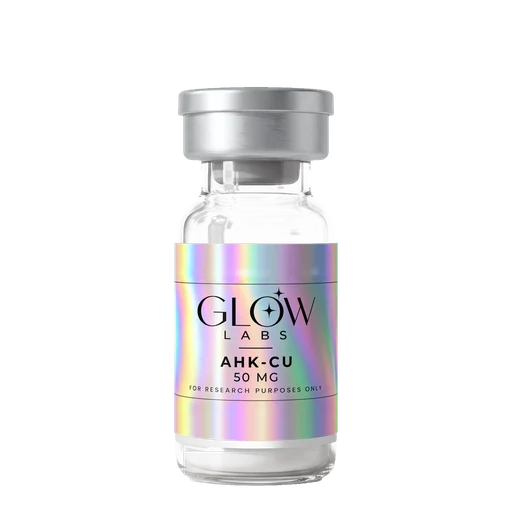
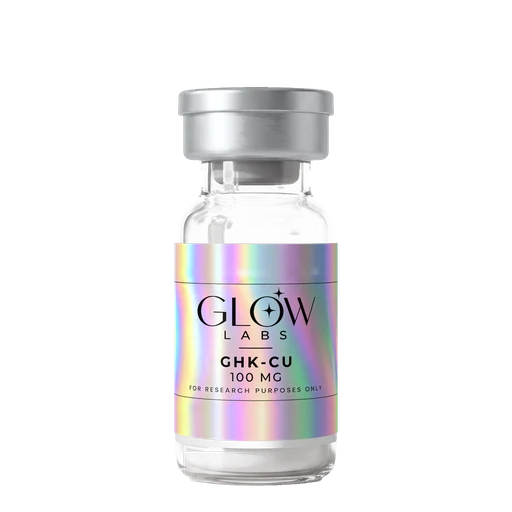
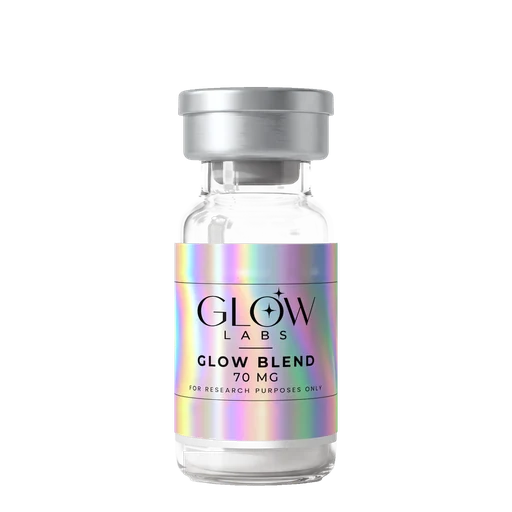
Glow Labs sells both as lyophilised research vials: see AHK-Cu and GHK-Cu. GHK-Cu is also part of the GLOW blend. For the full GHK-Cu story, read what GHK-Cu is. Our peptide purity guide explains how to read the certificate for either one. All are for lab research only, not for people or animals. Glow Labs posts every order tracked from Traralgon, and it arrives in 2-3 days.
FAQ
Is AHK-Cu just a modified GHK-Cu?
In a sense. It swaps glycine for alanine at the first position, so it is a close analogue. Because the chain is different, it is a separate molecule with its own data, and findings for one do not carry over to the other.
What is AHK-Cu?
AHK-Cu is a lab made copper tripeptide with the sequence Ala-His-Lys. Our PubMed search of 25 October 2026 found just one study of it, done in vitro. By the same dated search, GHK with copper had 92 records, so GHK-Cu has far more research.
Is either approved in Australia?
GHK-Cu is named by the TGA among unapproved peptide products. AHK-Cu did not appear in the TGA material we checked, and absence there is not the same as approval.
Sources: Glow Labs PubMed search, GHK[tiab] AND copper[tiab] (title and abstract), 25 October 2026: 92 records. Therapeutic Goods Administration, Understanding your responsibilities when importing, compounding and supplying unapproved peptide products, Safety advisory, 13 April 2026. Glow Labs PubMed search, AHK-Cu[tiab], 25 October 2026: 1 record. Glow Labs PubMed search, AHK[tiab] AND copper[tiab], 25 October 2026: 1 record.
Sources
- PubChem compound record CID 73587 (glycyl-L-histidyl-L-lysine, GHK), US National Library of Medicine.
- PubChem compound record CID 7408502 (L-alanyl-L-histidyl-L-lysine, AHK), US National Library of Medicine.
- PubChem compound record CID 139035031 (copper tripeptide, GHK-Cu), US National Library of Medicine.
- PubChem compound record CID 168431292 (AHK copper complex, hydrochloride record), US National Library of Medicine.
- Pyo HK et al, The effect of tripeptide-copper complex on human hair growth in vitro, Arch Pharm Res, 2007.
- Pickart L et al, J Cell Physiol, 1980.
- Pickart L, The human tri-peptide GHK and tissue remodeling, J Biomater Sci Polym Ed, 2008.
- Pickart L et al, GHK Peptide as a Natural Modulator of Multiple Cellular Pathways in Skin Regeneration, Biomed Res Int, 2015.
- Alshammari N, Platts JA, Theoretical study of copper binding to GHK peptide, Comput Biol Chem, 2020.
- Glow Labs PubMed search, GHK[tiab] AND copper[tiab] (title and abstract), 25 October 2026: 92 records.
- Mateescu DM et al, Pharmaceutics, 2026.
- Therapeutic Goods Administration, Understanding your responsibilities when importing, compounding and supplying unapproved peptide products, Safety advisory, 13 April 2026.
- Glow Labs PubMed search, GHK-Cu[tiab], 25 October 2026: 83 records.
- Glow Labs PubMed search, GHK[tiab] AND copper[tiab] AND review[pt], 25 October 2026: 8 records.
- Glow Labs PubMed search, GHK[tiab] AND copper[tiab] AND clinical trial[pt], 25 October 2026: 1 record.
- Glow Labs PubMed search, GHK[tiab] AND copper[tiab] AND (animals[mh] NOT humans[mh]), 25 October 2026: 16 records.
- Glow Labs PubMed search, AHK-Cu[tiab], 25 October 2026: 1 record.
- Glow Labs PubMed search, AHK[tiab] AND copper[tiab], 25 October 2026: 1 record.