What is PT-141?
PT-141 and bremelanotide are two names for the same molecule. PT-141 is the code used while it was being developed. Bremelanotide is its official generic name. It is a synthetic copy of part of alpha-MSH, a natural hormone in the melanocortin family.
Melanocortins are a group of hormones that act on a set of melanocortin receptors. Those receptors sit in different tissues. That is one reason lab-made melanocortin peptides can act so differently.
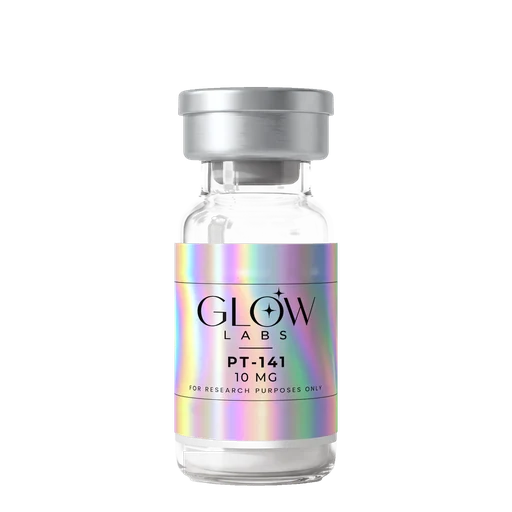
Glow Labs supplies PT-141 research vials, 10mg, for laboratory study only.
Sources: PubChem, Bremelanotide, CID 9941379, National Library of Medicine. Dhillon S, Keam SJ, Bremelanotide: first approval, Drugs, 2019. Molinoff PB et al, PT-141: a melanocortin agonist for the treatment of sexual dysfunction, Ann N Y Acad Sci, 2003.
Questions about this guide?
Ask on WhatsAppWhat the name means
"PT-141" is a development code, not a description of what the molecule does. A 2004 profile describes it as a modified analogue of an earlier compound coded PT-14. Codes like this are common in drug research. They let a team track hundreds of candidate molecules before any of them gets a real name. Compounds usually get a generic name once they reach clinical trials. That is how PT-141 became bremelanotide.
Sources: PubChem, Bremelanotide, CID 9941379, National Library of Medicine. Hedlund P, Curr Opin Investig Drugs, 2004.
Structure
| Property | Value |
|---|---|
| Generic name | Bremelanotide |
| Code name | PT-141 |
| Length | 7 amino acids |
| Shape | Cyclic (ring) peptide |
| Formula | C50H68N14O10 |
| Molecular weight | 1025.2 g/mol |
| PubChem record | CID 9941379 |
| Supplied as | lyophilised powder |
The ring matters. Its ring is closed by a bond between the side chains of two of its amino acids, aspartic acid and lysine. This lets it hold a tighter shape than a straight chain. That shape affects which receptors it fits and how long it survives enzymes.
Sources: PubChem, Bremelanotide, CID 9941379, National Library of Medicine.
Where it came from
PT-141 grew out of melanocortin research in the 1990s and early 2000s. Scientists were studying lab-made versions of alpha-MSH. One of them was melanotan II, another ring-shaped peptide. The TGA has since warned about melanotan II in tanning products. PT-141 is a very close chemical relative of melanotan II. Their PubChem formulas differ by only a few atoms, at one end of the molecule.
The team developing PT-141 published a paper on it in 2003. It was the first paper on PubMed under its code name. The paper called the molecule an agonist, meaning an activator. It acts at melanocortin receptors, including MC3R and MC4R.
Sources: PubChem, Bremelanotide, CID 9941379, National Library of Medicine. Molinoff PB et al, PT-141: a melanocortin agonist for the treatment of sexual dysfunction, Ann N Y Acad Sci, 2003. PubChem, Melanotan-II, CID 92432, National Library of Medicine. Therapeutic Goods Administration, Melanotan II tanning peptide products found to be inconsistently dosed, Safety alert, 17 August 2026.
How it acts
The papers say bremelanotide activates melanocortin receptors. It has high affinity for MC4R, which means it binds that receptor tightly. The MC3 and MC4 receptors are found mostly in the brain. So researchers describe its action as working through brain pathways.
Sources: PubChem, Bremelanotide, CID 9941379, National Library of Medicine. Dhillon S, Keam SJ, Bremelanotide: first approval, Drugs, 2019. Molinoff PB et al, PT-141: a melanocortin agonist for the treatment of sexual dysfunction, Ann N Y Acad Sci, 2003.
Approval history
Bremelanotide was approved by the US Food and Drug Administration in 2019. The approval is for women before menopause who have one specific diagnosed condition. That condition is acquired generalised hypoactive sexual desire disorder. The 2019 Drugs review says this FDA approval was its first approval anywhere.
The trial evidence behind it is debated. A 2024 critical review made two points. It argued that the trial measures had weak validation. It also argued that the effect sizes were small. We report that debate as a fact about the literature, not as a view on any use.
Bremelanotide did not appear in any TGA page we read. So its Australian registration status is left open here. Glow Labs supplies PT-141 for laboratory research only, not for people.
Sources: Dhillon S, Keam SJ, Bremelanotide: first approval, Drugs, 2019. Mayer D, Lynch SE, Bremelanotide: new drug approved for treating hypoactive sexual desire disorder, Ann Pharmacother, 2020. Spielmans GI, Small effects, questionable outcomes: bremelanotide for hypoactive sexual desire disorder, J Sex Res, 2024.
Melanocortin family
PT-141 belongs to a small family of lab-made melanocortin peptides. Here they are side by side.
| Melanotan I (afamelanotide) | Melanotan II | Bremelanotide (PT-141) | |
|---|---|---|---|
| Length | 13 amino acids | 7 amino acids | 7 amino acids |
| Shape | Straight chain | Cyclic | Cyclic |
| Formula | C78H111N21O19 | C50H69N15O9 | C50H68N14O10 |
| Receptor named in our sources | MC1R | not set out in our sources | MC3R and MC4R, highest affinity for MC4R |
| Regulator approval | EU, US FDA 2019, and registered in Australia since 2020, for a rare light-sensitivity disorder | None; TGA says it is prescription only here, with no approved product | US FDA, 2019 |
Our melanotan 1 vs 2 guide explains how melanotan I and II differ from each other.
Sources: PubChem, Bremelanotide, CID 9941379, National Library of Medicine. Dhillon S, Keam SJ, Bremelanotide: first approval, Drugs, 2019. Molinoff PB et al, PT-141: a melanocortin agonist for the treatment of sexual dysfunction, Ann N Y Acad Sci, 2003. PubChem, Melanotan-II, CID 92432, National Library of Medicine. PubChem, Afamelanotide, CID 16197727, National Library of Medicine. Kim ES, Garnock-Jones KP, Afamelanotide: a review in erythropoietic protoporphyria, Am J Clin Dermatol, 2016. Therapeutic Goods Administration, Melanotan II tanning peptide products found to be inconsistently dosed, Safety alert, 17 August 2026. Therapeutic Goods Administration, AusPAR: afamelanotide, March 2021. US Food and Drug Administration, Drugs@FDA, NDA 210797, afamelanotide, first approved 8 October 2019.
PT-141 vs MT-II
People often confuse these two, and for good reason. They share an origin, a ring shape and nearly the same formula. But they are not the same compound, and regulators treat them differently. In August 2026 the TGA warned about melanotan II tanning products. It said the substance is prescription only in Australia, with no approved product here. That alert is about melanotan II. It does not cover bremelanotide.
Sources: PubChem, Bremelanotide, CID 9941379, National Library of Medicine. Molinoff PB et al, PT-141: a melanocortin agonist for the treatment of sexual dysfunction, Ann N Y Acad Sci, 2003. PubChem, Melanotan-II, CID 92432, National Library of Medicine. Therapeutic Goods Administration, Melanotan II tanning peptide products found to be inconsistently dosed, Safety alert, 17 August 2026.
Storing PT-141 vials
PT-141 is supplied as a freeze-dried powder. Keep the sealed vial cold, dry and dark until it is used in the lab. See the peptide storage guide for fridge and freezer advice. For how Glow Labs sells, read our research use notice.
FAQ
What does PT-141 stand for?
It is a development code given while the molecule was in research. It does not describe an effect. The generic name is bremelanotide.
Is PT-141 the same as melanotan II?
No. They are close chemical relatives with similar ring shapes. But their formulas differ, and regulators treat them as different substances.
Is PT-141 a hormone?
It is a synthetic peptide modelled on alpha-MSH, a natural hormone. It is not a natural hormone itself.
Is PT-141 approved anywhere?
Yes. The US FDA approved bremelanotide in 2019. The approval covers one condition in women before menopause. We found no Australian registration in our sources.
How are PT-141 research vials stored?
Sealed, dry and cold, away from light, until they are used in the lab.
Sources
- PubChem, Bremelanotide, CID 9941379, National Library of Medicine.
- Dhillon S, Keam SJ, Bremelanotide: first approval, Drugs, 2019.
- Mayer D, Lynch SE, Bremelanotide: new drug approved for treating hypoactive sexual desire disorder, Ann Pharmacother, 2020.
- Molinoff PB et al, PT-141: a melanocortin agonist for the treatment of sexual dysfunction, Ann N Y Acad Sci, 2003.
- Hedlund P, Curr Opin Investig Drugs, 2004.
- Spielmans GI, Small effects, questionable outcomes: bremelanotide for hypoactive sexual desire disorder, J Sex Res, 2024.
- PubChem, Melanotan-II, CID 92432, National Library of Medicine.
- PubChem, Afamelanotide, CID 16197727, National Library of Medicine.
- Kim ES, Garnock-Jones KP, Afamelanotide: a review in erythropoietic protoporphyria, Am J Clin Dermatol, 2016.
- Therapeutic Goods Administration, Melanotan II tanning peptide products found to be inconsistently dosed, Safety alert, 17 August 2026.
- Therapeutic Goods Administration, AusPAR: afamelanotide, March 2021.
- US Food and Drug Administration, Drugs@FDA, NDA 210797, afamelanotide, first approved 8 October 2019.