In Australia, both are prescription-only medicines. The Therapeutic Goods Administration (TGA) has approved an afamelanotide implant for one rare condition. It has approved no melanotan II product.
At a glance
Melanotan 1, also called afamelanotide, is an open chain of 13 amino acids. Its main target is one receptor, MC1R. Melanotan 2 is a smaller peptide of 7 amino acids. A lactam bridge closes 6 of them into a ring. It acts on several melanocortin receptors at once.
| Melanotan 1 (MT-1) | Melanotan 2 (MT-2) | |
|---|---|---|
| Other name | afamelanotide | melanotan II |
| Length | 13 amino acids | 7 amino acids |
| Shape | linear, no ring | cyclic, closed by a lactam bridge |
| Formula | C78H111N21O19 | C50H69N15O9 |
| Molar mass | about 1,646.8 g/mol | about 1,024.2 g/mol |
| Receptor profile | MC1R agonist | non-selective melanocortin agonist |
| Approved medicine? | yes, as an implant for one rare condition, in the EU, US and Australia | none we could source |
| Australian status | prescription only (Schedule 4); one implant product entered on the ARTG in 2020 | prescription only (Schedule 4), no product on the ARTG |
Sources: PubChem compound record CID 16197727 (afamelanotide). PubChem compound record CID 92432 (melanotan II). Kim ES, Garnock-Jones KP, Am J Clin Dermatol, 2016. US prescribing information for an afamelanotide implant, DailyMed, US National Library of Medicine, label version of May 2026. Peters B et al, CEN Case Rep, 2020. TGA, Safety alert on melanotan II products, 17 August 2026. TGA, Australian Public Assessment Report for afamelanotide, March 2021. Poisons Standard, October 2026, Schedule 4.
Questions about this guide?
Ask on WhatsAppWhat is MT-1?
MT-1 is afamelanotide. It keeps the 13 amino acid backbone of natural alpha-MSH and swaps two of them. Position 4 becomes norleucine, and position 7 becomes the mirror-image D-form of phenylalanine.
A 2016 review says afamelanotide was the first drug of its kind to act on MC1R. That is the melanocortin-1 receptor. Of the two, only it has been through full clinical trials and review by regulators. It is approved as a slow-release implant for erythropoietic protoporphyria (EPP). EPP is a rare inherited condition in which light on the skin causes pain.
Sources: PubChem compound record CID 16197727 (afamelanotide). Kim ES, Garnock-Jones KP, Am J Clin Dermatol, 2016. Wensink D, Wagenmakers MAEM, Langendonk JG, Expert Rev Clin Pharmacol, 2021.
What is MT-2?
MT-2 is melanotan II, the compound tested in a 1996 pilot study. It is a 7 amino acid peptide built from positions 4 to 10 of alpha-MSH. A lactam bridge joins aspartic acid to lysine. It closes 6 of them into a ring and leaves norleucine outside it. Its full structure is Ac-Nle-cyclo[Asp-His-D-Phe-Arg-Trp-Lys]-NH2.
MT-2 has never been approved as a medicine anywhere we could source. A 2020 review calls it a non-selective melanocortin agonist. That means it acts on several receptors in the family, not just one.
Sources: PubChem compound record CID 92432 (melanotan II). Dorr RT et al, Life Sci, 1996. Peters B et al, CEN Case Rep, 2020.
How they differ
The two share a parent hormone but little else.
- Shape. MT-1 is an open chain with two free ends. MT-2 is closed into a ring.
- Size. MT-1 has 13 amino acids and MT-2 has 7, so MT-2 weighs roughly 40 percent less.
- Targets. MT-1 is described as acting on MC1R. MT-2 is described as non-selective: it reaches several receptors in the melanocortin family.
- Testing. MT-1 has phase 3 trial data and a regulator-approved label. MT-2 has a small 1996 pilot study and a set of case reports.
Sources: PubChem compound record CID 16197727 (afamelanotide). PubChem compound record CID 92432 (melanotan II). Dorr RT et al, Life Sci, 1996. Kim ES, Garnock-Jones KP, Am J Clin Dermatol, 2016. Peters B et al, CEN Case Rep, 2020.
Where it is approved
The 2016 review says afamelanotide is approved in the European Union for adults with EPP. There it is used to prevent harm from light. In the United States it has a full label as an implant for the same use. The label is on DailyMed, a US National Library of Medicine service. In Australia, the TGA approved an afamelanotide implant for adults with EPP in October 2020. A 2021 review covers the implant's approved use in EPP.
We could not find any regulator approval for melanotan II in any country.
Sources: Kim ES, Garnock-Jones KP, Am J Clin Dermatol, 2016. Wensink D, Wagenmakers MAEM, Langendonk JG, Expert Rev Clin Pharmacol, 2021. US prescribing information for an afamelanotide implant, DailyMed, US National Library of Medicine, label version of May 2026. TGA, Australian Public Assessment Report for afamelanotide, March 2021.
Rules in Australia
Afamelanotide is a prescription-only medicine here. The Poisons Standard lists it in Schedule 4. Medicines in that group need a prescription. A TGA report covers an afamelanotide implant for adults with EPP. It says the implant joined the Australian Register of Therapeutic Goods (ARTG) in November 2020.
The TGA put out a safety alert on 17 August 2026. It said melanotan II is prescription only here. It said the ARTG holds no product containing it. Seized products were also tested. The amount of peptide varied between bottles, the alert said.
A TGA media release of 21 May 2026 reported 27 infringement notices, totalling 101,412 AUD. They went to one person in New South Wales. The notices were for allegedly supplying melanotan II. The fines were paid that month.
Sport Integrity Australia's peptides page names melanotan II as an unapproved peptide. A 2017 review adds that health bodies in several countries have warned about melanotan I and II.
Sources: Habbema L et al, Int J Dermatol, 2017. TGA, Safety alert on melanotan II products, 17 August 2026. Sport Integrity Australia, Peptides explained, Substance education. TGA, Australian Public Assessment Report for afamelanotide, March 2021. TGA, ARTG entry 327947, afamelanotide implant. Poisons Standard, October 2026, Schedule 4. TGA media release on melanotan II infringement notices, 21 May 2026.
Regulator record
Here is the official record in one place.
| Date | Body | What it said or did |
|---|---|---|
| EU approval, per 2016 review | European regulator | afamelanotide approved as an implant for EPP |
| 22 October 2020 | TGA | afamelanotide implant approved for adults with EPP, then entered on the ARTG on 18 November 2020 |
| Label version May 2026 | US National Library of Medicine (DailyMed) | current US prescribing label for the afamelanotide implant |
| 21 May 2026 | TGA | 27 infringement notices, 101,412 AUD, issued to a New South Wales individual over alleged melanotan II supply |
| 17 August 2026 | TGA | melanotan II is prescription only, with no ARTG product; testing found variable amounts |
| In force from 1 October 2026 | Poisons Standard | afamelanotide and melanotan II both listed in Schedule 4 |
| Current | Sport Integrity Australia | melanotan II listed among unapproved peptide products |
Sources: Kim ES, Garnock-Jones KP, Am J Clin Dermatol, 2016. US prescribing information for an afamelanotide implant, DailyMed, US National Library of Medicine, label version of May 2026. TGA, Safety alert on melanotan II products, 17 August 2026. Sport Integrity Australia, Peptides explained, Substance education. TGA, Australian Public Assessment Report for afamelanotide, March 2021. Poisons Standard, October 2026, Schedule 4. TGA media release on melanotan II infringement notices, 21 May 2026.
Where PT-141 fits
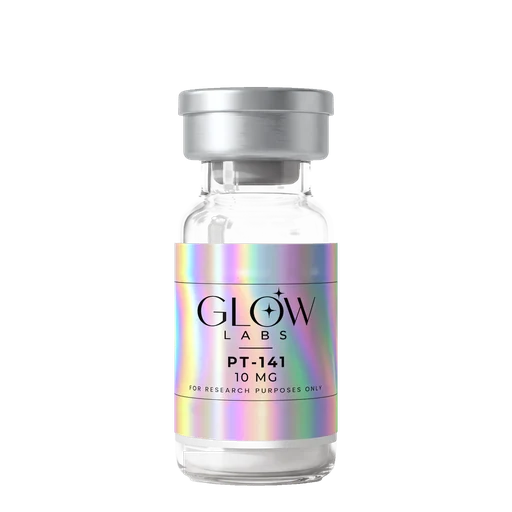
PT-141, or bremelanotide, is a close chemical cousin of MT-2. Both have 7 amino acids, with 6 of them in the same ring. PubChem lists almost identical formulas for them. They are separate compounds with their own records. Our PT-141 guide covers bremelanotide. The PT-141 research vial sits in the same melanocortin research area.
Sources: PubChem compound record CID 92432 (melanotan II). PubChem compound record CID 9941379 (bremelanotide).
Storing vials
Both peptides contain tryptophan, an amino acid that oxidises easily. A peptide handling guide advises keeping freeze-dried vials sealed, frozen and dry. See how to store peptides for the full steps.
This page is education about published research and regulator records.
Sources: PubChem compound record CID 16197727 (afamelanotide). PubChem compound record CID 92432 (melanotan II). Bachem, Handling and storage guidelines for peptides, Knowledge Center.
FAQ
What is the difference between melanotan 1 and melanotan 2?
MT-1 (afamelanotide) is a straight chain of 13 amino acids. It acts mainly on MC1R. MT-2 is a 7 amino acid peptide closed into a ring. It acts on several melanocortin receptors. Only afamelanotide has an approved medical form.
Is melanotan 1 the same as afamelanotide?
Yes. Afamelanotide is the drug name for what early research called Melanotan 1. It is a copy of alpha-MSH with two amino acids swapped.
Is melanotan 1 legal in Australia?
In Australia, afamelanotide is a prescription-only medicine. It is listed in Schedule 4 of the Poisons Standard. The TGA approved one implant form of it for adults with EPP in 2020.
Is melanotan 2 legal in Australia?
It is a prescription-only medicine. Schedule 4 of the Poisons Standard lists it. The TGA's August 2026 alert said the ARTG lists no product containing it.
Why has the TGA warned about melanotan II?
Its August 2026 alert said tests on seized products found uneven amounts. The peptide amount differed from bottle to bottle. A May 2026 TGA media release also reported infringement notices against one person in New South Wales.
What is the advice on melanotan storage?
A handling guide says sealed, frozen and dry. Both peptides contain tryptophan, which oxidises.
Sources: PubChem compound record CID 16197727 (afamelanotide). PubChem compound record CID 92432 (melanotan II). Kim ES, Garnock-Jones KP, Am J Clin Dermatol, 2016. TGA, Safety alert on melanotan II products, 17 August 2026. Bachem, Handling and storage guidelines for peptides, Knowledge Center. TGA, Australian Public Assessment Report for afamelanotide, March 2021. Poisons Standard, October 2026, Schedule 4. TGA media release on melanotan II infringement notices, 21 May 2026.
Sources
- PubChem compound record CID 16197727 (afamelanotide).
- PubChem compound record CID 92432 (melanotan II).
- Dorr RT et al, Evaluation of melanotan-II, a superpotent cyclic melanotropic peptide in a pilot phase-I clinical study, Life Sci, 1996.
- Kim ES, Garnock-Jones KP, Afamelanotide: a review in erythropoietic protoporphyria, Am J Clin Dermatol, 2016.
- Wensink D, Wagenmakers MAEM, Langendonk JG, Afamelanotide for prevention of phototoxicity in erythropoietic protoporphyria, Expert Rev Clin Pharmacol, 2021.
- US prescribing information for an afamelanotide implant, DailyMed, US National Library of Medicine, label version of May 2026.
- Peters B et al, Melanotan II: a possible cause of renal infarction: review of the literature and case report, CEN Case Rep, 2020.
- Habbema L et al, Risks of unregulated use of alpha-melanocyte-stimulating hormone analogues: a review, Int J Dermatol, 2017.
- TGA, Safety alert on melanotan II products, 17 August 2026.
- Sport Integrity Australia, Peptides explained, Substance education.
- PubChem compound record CID 9941379 (bremelanotide).
- Bachem, Handling and storage guidelines for peptides, Knowledge Center.
- TGA, Australian Public Assessment Report for afamelanotide, March 2021.
- TGA, ARTG entry 327947, afamelanotide implant.
- Poisons Standard, October 2026, Schedule 4.
- TGA media release on melanotan II infringement notices, 21 May 2026.