One key difference
Both products start as the same thing: a sterile, purified grade of water. It is free of pyrogens, the bacterial fragments that can cause a fever. The bacteriostatic version then has benzyl alcohol added at 0.9 percent, which is 9 mg in every millilitre. Some products use 1.1 percent instead.
That preservative changes how the vial can be handled. A sealed vial of either product is sterile. The problem starts once the stopper has been pierced, because each entry can carry microbes in. A preservative slows their growth between entries. Plain sterile water has no such protection. Its label says to throw away whatever is left after one use.
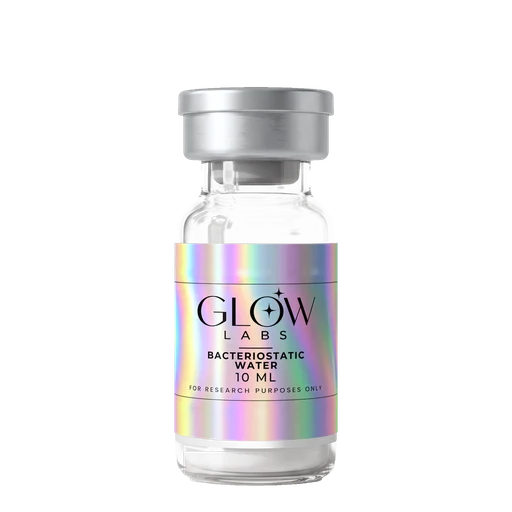
Glow Labs stocks bacteriostatic water as a laboratory supply in 3ml, 5ml and 10ml vials.
Sources: Hospira, Bacteriostatic Water for Injection, USP: product label (multiple-entry vial), DailyMed, US National Library of Medicine. Medefil, Sterile Water for Injection, USP: product label (single-use container), DailyMed, US National Library of Medicine.
Questions about this guide?
Ask on WhatsAppSide by side
This table summarises the two labels, so you can check each line yourself.
| Feature | Bacteriostatic water (Hospira label) | Sterile water (Medefil label) |
|---|---|---|
| Base | Sterile, nonpyrogenic purified water | Sterile, nonpyrogenic purified water |
| Added preservative | Benzyl alcohol, 0.9% or 1.1% | None: no bacteriostat, antimicrobial agent or added buffer |
| Container type | Multiple-entry vial | Single-use containers only |
| Leftovers | Repeated withdrawals allowed | Discard unused portion; do not reuse |
| pH on the label | 5.7 (range 4.5 to 7.0) | 5.0 to 7.0 |
| Label storage | 20 to 25 °C, controlled room temperature | 20 to 25 °C; protect from freezing |
| Newborn warning | Not for use in neonates | No benzyl alcohol warning |
| Before use | Use only if clear and the seal is intact | Use only if clear and the seal is intact |
Both labels also say to follow the maker of whatever is being dissolved on the choice of liquid. That rule sits above any general comparison.
Sources: Hospira, Bacteriostatic Water for Injection, USP: product label (multiple-entry vial), DailyMed, US National Library of Medicine. Medefil, Sterile Water for Injection, USP: product label (single-use container), DailyMed, US National Library of Medicine.
What the word means
"Bacteriostatic" means it stops bacteria from multiplying. It does not mean it kills every microbe on contact. Think of it as a brake, not a bleach.
Benzyl alcohol is a simple aromatic alcohol with the formula C7H8O. It is a common preservative in medicines made for more than one use. A 2023 review looked at preservatives in protein and peptide products. It explains that any product meant for repeated use needs one to stop microbes growing. The same review warns that some preservatives can make proteins and peptides more likely to form particles. This means the preservative has to suit the active ingredient.
Why does this matter? In a hospital study in Iran, bacteria were found in 36 of 637 opened multi-use vials, about 5.6 percent. Preservatives are added to slow bacterial growth, the 2023 review explains. They do not replace clean handling, which the study authors said should be stressed.
Sources: PubChem compound record: Benzyl alcohol (CID 244), US National Library of Medicine. Stroppel L et al, Antimicrobial preservatives for protein and peptide formulations: an overview, Pharmaceutics, 2023. Motamedifar M et al, Am J Infect Control, 2009.
WFI, sterile, saline
These names cause a lot of confusion, so here they are in plain terms.
- WFI is the short name for a highly purified grade of water defined in pharmacopoeias, the official books of drug standards. Both labels above describe their contents as a sterile preparation of this grade. The full official names appear in the source list at the end of this page.
- Sterile water is WFI-grade water sealed in a single-use container and sterilised. Nothing is added.
- Bacteriostatic water is the same grade of water with benzyl alcohol added, sealed in a vial built for repeated entry.
- Saline is sterile water with salt added. It is a separate product with its own label and its own uses.
Product names differ from country to country, and so does the wording on the box. The label text, not the brand, tells you which one you have.
Sources: Hospira, Bacteriostatic Water for Injection, USP: product label (multiple-entry vial), DailyMed, US National Library of Medicine. Medefil, Sterile Water for Injection, USP: product label (single-use container), DailyMed, US National Library of Medicine.
Fridge or shelf?
The Hospira label gives 20 to 25 °C for bacteriostatic water. It calls this controlled room temperature. It does not tell you to refrigerate it. The sterile water label gives the same range and adds that the product should be protected from freezing.
Keep both away from direct sun and heat. Once a peptide has been dissolved in either liquid, the storage rules change. Now you are storing the peptide. That side of things is explained in how to store peptides.
Sources: Hospira, Bacteriostatic Water for Injection, USP: product label (multiple-entry vial), DailyMed, US National Library of Medicine. Medefil, Sterile Water for Injection, USP: product label (single-use container), DailyMed, US National Library of Medicine.
Does it expire?
Yes. Every vial carries an expiry date printed by its maker. That date applies to a sealed, unopened vial.
After the first puncture, things are less clear. Many websites repeat a fixed number of days for opened bacteriostatic water. The Hospira label itself gives no such day count. It says to use aseptic technique for every entry, and to mix and use promptly. It also says not to store dissolved products unless the maker of that product says so. For sterile water, the answer is simple: one use, then discard what is left.
If a vial looks cloudy, has particles in it, or the seal is damaged, the labels say not to use it.
Sources: Hospira, Bacteriostatic Water for Injection, USP: product label (multiple-entry vial), DailyMed, US National Library of Medicine. Medefil, Sterile Water for Injection, USP: product label (single-use container), DailyMed, US National Library of Medicine.
The newborn warning
The bacteriostatic water label carries a bold warning line: not for use in neonates, meaning newborn babies. This is a label fact, not advice about any research use.
The warning has a history. In 1982, doctors described a serious illness in very premature babies, which they called gasping syndrome, and linked it to benzyl alcohol poisoning. The label says to use only sterile water with no preservative when making up medicines for newborns.
A separate 2017 review of cosmetic ingredients concluded that benzyl alcohol is safe in cosmetics at the levels used today. That review was about cosmetics, not other uses.
Sources: Hospira, Bacteriostatic Water for Injection, USP: product label (multiple-entry vial), DailyMed, US National Library of Medicine. Gershanik J et al, The gasping syndrome and benzyl alcohol poisoning, N Engl J Med, 1982. Johnson W et al, Safety assessment of benzyl alcohol, benzoic acid and its salts, and benzyl benzoate, Int J Toxicol, 2017.
Buying in Australia
Glow Labs lists bacteriostatic water under Supplies. It comes in 3ml ($10), 5ml ($15) and 10ml ($20) vials, with flat $10 tracked shipping per order, and the total is confirmed on WhatsApp before payment. Like every order, it ships tracked from Traralgon in Gippsland and arrives in 2-3 days. New to freeze-dried peptide powder? Start with our lyophilized peptide guide. Then see how to reconstitute peptides for the handling steps.
FAQ
Can I use sterile water instead of bacteriostatic water?
Sterile water is made for one use. Its label says not to reuse the container and to discard any unused portion. If a vial will be entered more than once, a preserved liquid is the type designed for that. Always check what the maker of the dissolved compound advises first.
Is WFI the same as sterile water?
WFI is the grade of water. Sterile water is a finished product made from that grade, sealed in a single-use container and sterilised. Bacteriostatic water uses the same grade with benzyl alcohol added.
Is bacteriostatic water the same as sterile water?
No. Both start as the same sterile, nonpyrogenic water, but bacteriostatic water has benzyl alcohol added, usually 0.9 percent, and comes in a multiple-entry vial. Sterile water has nothing added and is single use.
How long does bacteriostatic water last after opening?
The Hospira label gives no day count for an opened vial. Instead, it asks for aseptic technique each time the stopper is entered. The printed expiry date applies to the sealed vial only.
How should I store bac water?
Unopened, at room temperature, 20 to 25 °C, out of the sun. Keep the stopper clean, and do not use a vial that is cloudy or has a broken seal.
Sources: Hospira, Bacteriostatic Water for Injection, USP: product label (multiple-entry vial), DailyMed, US National Library of Medicine. Medefil, Sterile Water for Injection, USP: product label (single-use container), DailyMed, US National Library of Medicine.
Sources
- Hospira, Bacteriostatic Water for Injection, USP: product label (multiple-entry vial), DailyMed, US National Library of Medicine.
- Medefil, Sterile Water for Injection, USP: product label (single-use container), DailyMed, US National Library of Medicine.
- PubChem compound record: Benzyl alcohol (CID 244), US National Library of Medicine.
- Stroppel L et al, Antimicrobial preservatives for protein and peptide formulations: an overview, Pharmaceutics, 2023.
- Motamedifar M et al, The prevalence of multidose vial contamination by aerobic bacteria in a major teaching hospital, Shiraz, Iran, 2006, Am J Infect Control, 2009.
- Gershanik J et al, The gasping syndrome and benzyl alcohol poisoning, N Engl J Med, 1982.
- Johnson W et al, Safety assessment of benzyl alcohol, benzoic acid and its salts, and benzyl benzoate, Int J Toxicol, 2017.